Riding the forgotten charcoal trails of Japan.
words & photography :: Ben Haggar

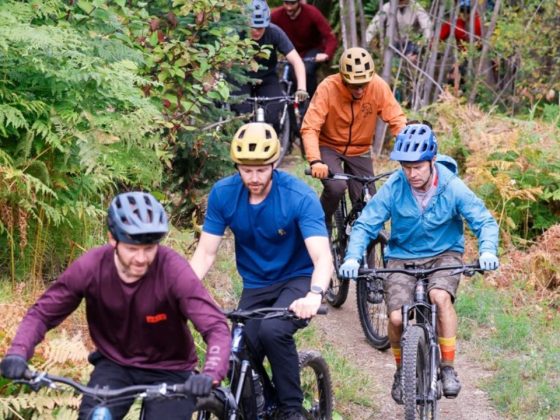
It’s hard to believe this trail wasn’t made for mountain bikes. Following an undulating ridge line, the singletrack snakes its way through the satoyama, an open natural hardwood forest. As the grade steepens, the trail burrows into the slick, clay-based soil, sculpting half-pipe walls that switch back, swell and tighten with the terrain. Perfectly radiused corners gather the falling leaves, creating a trail bed soft enough to drift the back end in a playful slash, but with ample traction to hold a line into the next wall. It feels like the summer version of the famous “Japow” snow days—and I’m addicted.
Unbelievably, when these trails were built, the invention of the bicycle was still more than 1,000 years in the future.
We’re in Japan to ride the forgotten trails of the Nishi-Izu Skyline, which dates back to the Heian period (794–1185 AD). This anachronistic network of roads and paths was used to connect villages and temples, with arteries snaking high up the narrow ridges into the satoyama, where charcoal was collected to fuel the houses and kitchens of Izu as well as Edo (modern-day Tokyo).

For much of Japan’s history, charcoal served as the main energy source for heating and cooking. Over centuries, charcoal production became a highly specialized craft, evolving beyond its utilitarian usage into an art form. One traditional usage of charcoal involves rendering slow-burning hardwoods like ubame oak, tsubaki (Japanese hornbeam) and buna (Japanese beech) with flame in a low-oxygen kiln high in the hills, creating a product that is almost pure carbon. Individual processes result in different types of charcoal, each with unique properties, colours and uses—for specialized dishes like kushiyaki (skewered grilled foods), on large open grills for robatayaki, or for smoking bonito flakes, known locally asizu-bushi.

The charcoal industry thrived nationwide until World War II when the adoption of petroleum-based fuels, natural gas and widespread electricity usurped traditional methods. The craft of charcoal production rapidly disappeared, and with it much of the rural population and their time-honoured traditions—along with a legacy of responsible forest management. The satoyama quietly reclaimed the historic mountain roads and foot paths used to extricate the resource until they were virtually lost from memory.
Related content from ML:
When Junichiro Matsumoto heard from a village elder that 1,200-year-old mountain roads and trails were buried in the hills, he knew he had to search for them. A Yokohama native, Matsumoto’s thirst for exploration began while hitchhiking around Japan in his youth, which led to sojourns through Asia, the Middle East and South America by motorcycle and on foot. While hiking in the Himalaya, Karakoram and South America, Matsumoto discovered a deep passion for the intersection of history, culture and adventure that ancient trails weave together. Inevitably, his curiosity transformed into obsession, unearthing trails in his backyard that were much older than those of the Inca he had hiked on the other side of the planet.

Matsumoto hunted down a map from the Meiji period (1868 –1912) and got to work searching out the paths. A key feature of the trails became apparent. “At first, I started maintenance work alone, lugging a hoe and chainsaw,” he says. “But as I cleared away fallen leaves, earth and trees, I found a number of kannon and stone monuments.” Kannon are memorial headstones, in this case for horses. Horse-drawn sleds were used to transport charcoal off the local mountains, and some kannon were emblazoned with a handprint and horseshoe to represent the deep bond between the hardworking teams. From his extensive motorcycle background, Matsumoto realized that the winding halfpipe features created through centuries of gradual sled erosion would be perfect for mountain biking.
As Matsumoto envisioned, these ancient trails, beaten into submission through a millennium of compaction, are perfect in their original form, requiring little alteration or maintenance apart from the addition of drainage and removal of deadfall. The sled-hewn lines feel natural—both within the terrain and under our tires—with a vibe more akin to freeriding than trail riding. The wide trail bed with steeply banked, twisting walls allows for endless creativity in line choice as we race to keep up with our guide, Keitaro. It’s a unique sense of freedom not typically found on purpose-built singletrack. Each lap is a new opportunity to refine line choice and personal expression, while discovering previously unseen features.
“These ancient trails, beaten into submission through a millennium of compaction, are perfect in their original form, requiring little alteration or maintenance…”

Creating mountain bike trails in Japan, however, is not as straightforward as clearing brush and pointing a bike downhill. In 2012, Matsumoto began the complex task of obtaining permissions to uncover and transform the trails. “I attended council meetings in over 20 different villages and negotiated patiently,” says Matsumoto. “These are traditional, closed, rural communities, but surprisingly many of the elders supported the idea of a young guy in his 20s trying to create a new form of tourism. Their endorsement was the key.”
Over the past decade or so, he has unearthed seven paths totalling 40 kilometres and created Yamabushi Trail Tours, a private guiding operation on the exclusive trail network. Although one of Matsumoto’s goals was to create a nexus of legal mountain bike trails for everyone to ride, the endeavour is more nuanced. “If we were to open [the trails] to the general public, we would lose control over illegal riding, accidents and friction with the local community,” he says. “By keeping it strictly guided-only, we can ensure safety, maintain trail quality and, most importantly, keep our promise to the villagers that we will manage the mountains responsibly.” He and his team will guide between 10 to 20 riders on the trails per day in their high season.

Our next lap begins from Hozo, centuries-old, ornate Buddhist temple grounds carved from the forest. The traditional guardians of travelers, stone Jizo statues covered in moss and creeping vines line the sando (entry pathway) leading to the modest temple shaded by towering Japanese cedars. The primordial atmosphere sets the tone for the ride as we drop into a technical descent strewn with slick, moss-covered rocks and roots. Decrepit charcoal kilns and weather-worn kannon pass by in a mossy blur, though we stop to check out larger monuments at trail junctions (and take a much-needed rest). The breaks offer a chance to appreciate the uniqueness of the experience—in so many ways, this network is much more than just lines down a mountain.
Matsumoto’s commitment to the local community and the environment is earnest. Aging forestry workers could not properly manage the satoyama, which supports biodiversity and safeguards against landslides; Matsumoto’s maintenance efforts address this issue. The trails he works on also provide tsunami evacuation routes and allow access to the forest for villagers, who grow shiitake mushrooms in the area, as well as local hunters. The wood cut from trail and satoyama maintenance is sold to local restaurants and fuels Matsumoto’s own guesthouse and restaurant, Quebico, which is entirely fossil-fuel-free and powered exclusively by the harvested hardwood. He gives ash from the stoves to farmers for fertilizer and uses their vegetables in his restaurant. “By revitalizing ancient trails and properly thinning the trees, we have created a system where recreational use equals conservation,” says Matsumoto.

Back on the trails, one final push brings us to an open bluff overlooking the coast. As the sun sinks into the Philippine Sea, I reflect on how mountain biking can be a catalyst to new possibilities here. A huge portion of the population used to make their living from the mountain’s natural bounty, but with the adoption of modern fuels and mass urbanization, many rural Japanese communities face a slow demise—and with it a loss of history, culture and tradition. Mountain biking has the potential to change that. Through this reimagined trail network, Matsumoto is creating a framework for other rural Japanese communities to follow. With roughly 75 per cent of the country covered by mountains, with paths carved under the canopy over thousands of years, Japan’s riding potential is truly endless. More trails equal not only more fun, but the continuation of mountain culture.

Check the ML Podcast!