From ranch roads and rodeos to mountain highways and trout streams, one Albertan reflects on the people, places and enduring spirit that connect the many roads west.
Words & photos :: Bob Covey

Where the pavement ends
The last few kilometres before the trout streams are always the roughest.
The pavement disappears. Gravel turns to washboard. Then come the ruts and potholes.
Alberta’s 1,000-kilometre Forestry Trunk Road and its web of gravel arteries provide access to the Rockies’ eastern slopes. Those industry roads can be as unforgiving as the headwaters they lead to are pristine. If you’re chasing wild trout, the honey hole isn’t much use unless your vehicle can get you there.

I found myself thinking about one particularly molar-rattling stretch of road leading to a favourite tributary near Hinton recently while driving a GMC Canyon AT4 on a ranch south of Calgary. The occasion was part of GMC’s celebration of its 40-year partnership with the Calgary Stampede.


The ranch’s off-road course twisted through bermed corners, climbed steep grades and dropped into deep ruts carved by years of ranch traffic. Where I’d expected to be jostled around, the Canyon felt remarkably composed. It cornered confidently, settled quickly after sharp compressions and tracked smoothly through uneven terrain. Before long, I wasn’t thinking about the truck anymore—I was thinking about the roads that lead to the places I love most.


Years before I found myself driving GMC’s newest trucks on a media trip, I had a very different relationship with the Stampede.
Before long, I wasn’t thinking about the truck anymore—I was thinking about the roads that lead to the places I love most.
I grew up in Carstairs, Alberta, where grain elevators punctuated the skyline, rodeo posters hung in coffee shops and life revolved around agriculture. Ours wasn’t a ranching family. My friends and I gravitated toward skateboards, not horses. We liked punk rock, not country music.
Still, Western culture wasn’t something people in Carstairs performed. It was just…life.

Many of my classmates spent their summers feeding cattle before breakfast, fixing fences or helping with hay. Capability wasn’t a slogan. It was expected.
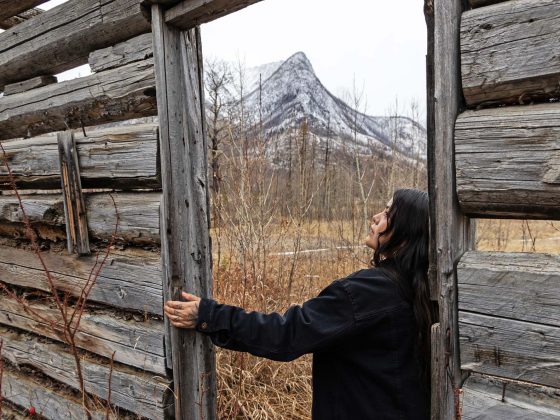
Not long after high school, I traded prairie horizons for mountain ones and settled in Jasper.
Living in the Rockies changed my understanding of the West, but it didn’t replace it.
The landscapes grew steeper, the rivers colder and there was more GORE-TEX than denim, yet I quickly realized Western culture had always belonged here, too. Jasper’s history is inseparable from the outfitters who first packed visitors into the backcountry by horse, opening valleys and alpine meadows that would become some of Canada’s most iconic mountain destinations.


The landscapes grew steeper, the rivers colder and there was more GORE-TEX than denim, yet I quickly realized Western culture had always belonged here, too.
Two kinds of horsepower
Those traditions haven’t disappeared, they’ve just evolved.
Today’s outfitters still saddle horses each morning, but they also hitch trailers, haul feed, tow equipment and drive hundreds of kilometres of mountain highways and forestry roads.

The tools have changed but the work hasn’t. In Alberta, horsepower has always been measured two ways.
That thought stayed with me as we explored GMC’s latest lineup of trucks and SUVs.
In Alberta, horsepower has always been measured two ways.
Standing beside the vehicles, I realized no two people were imagining the same destination.
One saw a dependable work truck, another pictured a family road trip, whereas someone else imagined towing horses to the next rodeo.


As for me, I was already thinking about those forestry roads west of Hinton.
Earlier that morning, I’d watched the Canyon AT4 soak up washboard gravel, climb loose grades and shrug off deep ruts without ever feeling unsettled. Looking across the lineup, it became clear that capability meant something different depending on who was behind the wheel. GMC’s trucks and SUVs weren’t trying to serve one lifestyle. They reflected many of them—from daily commutes and family camping trips to hauling equipment, towing trailers and exploring far beyond where the pavement ends.

The AT4 trim, available across much of the lineup, seemed built with exactly those kinds of adventures in mind. It offered the confidence to venture farther without sacrificing the comfort and technology that make long days behind the wheel enjoyable.
For me, it was easy to picture camping gear packed neatly in the bed, a drift boat or raft in tow and a fly rod waiting for first light beside another mountain stream.
Many roads west
A few days later I was back home in the Rockies, knee-deep in a mountain lake. The fish weren’t biting, leaving me plenty of time to think.

Growing up, I believed there was a clear divide between Alberta’s ranch country and its mountain culture.
Now I’m not so sure.
The farther I’ve wandered across this province, the more those worlds seem connected by the same qualities: hard work, self-reliance, time spent outdoors and a desire to see what’s beyond the next bend.
Growing up, I believed there was a clear divide between Alberta’s ranch country and its mountain culture. Now I’m not so sure.
Whether that journey begins in a ranch yard, a campground or a mountain trailhead, having the right vehicle simply means spending less time worrying about the road—and more time enjoying where it leads.
Perhaps that’s why GMC’s partnership with the Calgary Stampede has endured for four decades.


Like Alberta itself, it’s rooted in the understanding that there isn’t one way to experience the West.
There are simply many roads leading there.
Bob Covey was a guest of GMC Canada during the 2026 Calgary Stampede.

Check the ML Podcast!