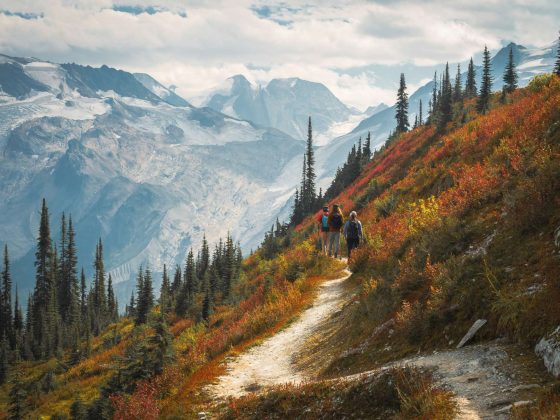
Lauren Moberly reconnects with her family’s land, history and guiding traditions.
words :: Sylvia Dekker // photos :: Megan Posein

Lauren Moberly rests her hand on the snug dovetailed corner of a cabin in the Athabasca Valley. The Douglas fir logs are faded grey, the cut ends rough against her fingers. One hundred and sixteen years ago, her great-great-grandfather Ewan Moberly stepped out of his doorway for the last time. It was locked behind him.
Today, his cabin is the oldest historical site in Jasper National Park, a short drive from the townsite and surrounded by burnt trees and two-year-old regrowth. When Ewan last surveyed the homestead he’d built, there were very few trees. Fields and gardens stretched out towards the mountains. Big open meadows fed his 200 horses which were rented by the likes of Mary Schäffer, one of the first non-Indigenous women to explore what is now Banff and Jasper. “If you went down the river you’d have to rent one of [my family’s] canoes,” says Lauren. Ewan’s homestead was one of six Rocky Mountain Cree and Mountain Métis homes sprinkled along the river. When geologist A.P. Coleman visited in 1907, he was wrote about self-sufficiency and success, a brimming smokehouse and fully stocked store, noting Ewan “had nearly everything humanity could want except bacon.”
The cabin, which Lauren describes as an impressive building for the time, rang with the noise of ten childhoods and music swelling from the family’s phonograph.
In 1910, the music stopped. “In order to provide for proper protection of the game and the administration of the [Jasper] Park Reserve,” wrote the Minister of the Interior in a letter to the Governor General in Council, “the acting Superintendent of the Park [is] instructed to arrange for the removal of these squatters.”
Hand on hip—classic Moberly fashion, she laughingly realizes—Lauren gestures to the cabin: “This was where they came to tell everybody about this change, that they had to leave.”
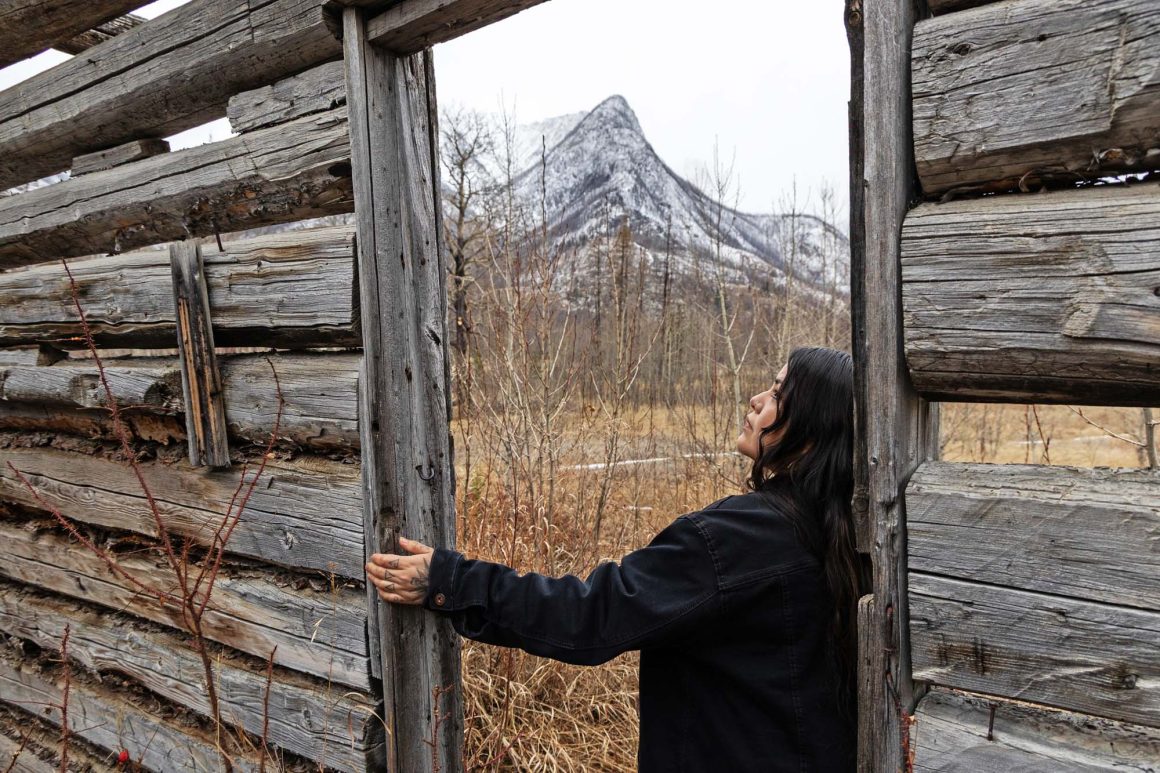
“This was where they came to tell everybody about this change, that they had to leave.”
The six assembled Rocky Mountain Cree and Mountain Metis families protested, but with their guns confiscated, the entrepreneurs and homesteaders had no choice but to abandon their homes, businesses and way of life.
To formalize the reluctant surrender of their land rights, each family was paid damages for removal and for the improvements they’d made to the land. Ewan was handed $1670, his son Aldolphus $180—a pitiful sum, equivalent to $45,000 and $5,000 today—and the money was gone long before the two-year journey was over. One tedious kilometre at a time, the families cut their own path of exodus out of the park boundaries, dragging farm machinery, herding cattle, and raising children. Stopping to winter in hastily built cabins meant being hounded by park officials. Many of the families eventually settled in the Grand Cache area, where Lauren and her family still live today. “It was so far away from everything but was where our families decided to rebuild their lives.” From scratch.
****
Lauren points out a silvery green stem beside the trail leading away from the cabin to a gravesite. Sage. A silver-bronze bush with deep blue berries. Juniper. Yarrow, wild rose, goldenrod. The Moberly Homestead has become her favourite place to forage for soap ingredients.
As the youngest of nine children, Lauren says she was lucky to be one of the few siblings allowed to skip school to join her parents on frequent trips to Jasper. Parallel to an ever deepening connection to the stories she heard during those visits, she vividly remembers a growing fear. After the Jasper Forest Reserve became National Park, bans on guns, horses, and outfitting operations—businesses that provided horses and guides—emerged alongside preservation ideals. “My mom would warn me if I even picked a flower, park officials would come get me.”
Related content from ML:
That sense of distance from the land followed her into adulthood, but it was the loss of beloved community elder Lucy Wanyandie—and with her, traditional tallow and ash soap making—that ignited Lauren’s entrepreneurial journey. Determined to revive the craft and bring the knowledge back to her community, Lauren taught herself soap making from scratch, foraging around Grand Cache for natural ingredients. Fallen Mountain Soaps, a collection of body products rooted in the Rockies, was born.
In 2020, she learned Indigenous partners were permitted to forage in Jasper for medicinal purposes. The ability to physically come back to and connect with her ancestral land via the scents and sensations of plants transformed her life and business.
It was like a reversal of Ewan’s experience, sparking a process of researching and a slow unearthing of her rich Aseniwuche Winewak (Rocky Mountain Cree) heritage. Now, she can’t absorb enough. “I am always learning more,” says Lauren. “I’m passionate about my community and sharing about who we are.” Soap was only the first step.
****
Lauren lifts a braid of sweetgrass, fallen from where it was draped on the spirit fence surrounding her great-great-great grandmother’s grave. Suzanne was born and raised in Jasper. After being abandoned by her husband Henry the day after their marriage, she managed a homestead and raised Ewan and John into success alone. Her grandson Adolphus, a highly sought-after mountain guide and trail packer, came home from guiding in his favourite place—Mt. Robson— with stories that flickered in her imagination.
In 1905, Adolphus and Suzanne set off to visit the highest peak in the Rockies. The esteemed matriarch would never witness the mountain, or the forced removal five years later, though. Suzanne fell ill on the journey and, forced to turn back, passed away on the travois mere kilometres from Ewan’s homestead.

This year, Lauren hopes to see Mt. Robson for the first time for both of them—from the air. As a partner with Jasper Hinton Air helicopter tours, Lauren’s mission to share has expanded from land-based body products into storytelling with an eagle-eye view. “All my ancestors were guides,” says Lauren. “I am the first aerial guide.”
“Guiding from the sky is reconciliation in a completely different way,” she says. It’s full circle Indigenous tourism, and for Lauren, feels like coming home.
Back on the ground at the Moberly homestead, Lauren weaves the sweatgrass back in place. She is reminded the Moberly legacy is stamped throughout the Rockies. “They were the forefathers of tourism in this area,” Lauren says. In fact, Miette Hotsprings is currently regaining a historical plaque featuring a familiar face: Ewan. As the story goes, after a successful hunt in the area he began skinning his ram. “He went to go wash his hands and the water was hot,” Lauren retells. He built a log pool, and the springs became a place of healing for his family and a destination he shared with his guiding clients.
“I’m still learning things about the land from the sky, and sharing [these stories]…gives me a bit of peace,” she says.
For Lauren, sharing takes many tangible forms: mixing traditional medicine into her nature based body products, providing Indigenous, land-based snacks for helicopter tour clients, piecing together family trees with youngsters in her own community and carrying on the relationship with Parks her parents forged when she was a child.
“Guiding from the sky is reconciliation in a completely different way.”
****
“See the darker part?” Lauren asks, gesturing to the deep orange-brown logs at the cabin’s peak, starkly contrasted with the century old, faded grey timbers. “My dad, Mike Moberly, did that.” In 2002, the carpenter carefully referenced old photos to restore the aging cabin to what looked like the day Ewan last stepped over the threshold.
Making sure places like these don’t disappear, along with the palpable stories floating through the gaps between the cabin’s logs, is essential to Lauren’s community. Despite the restoration, access remains limited.
“A lot of people in my community and my family haven’t even been inside [the cabin] yet,” says Lauren. As one of the few members with a deep connection to their ancestral home, she is trying to bridge reconciliation between her family and a place that holds so much history, heartache, and a layered fear. “A lot of [us] feel like strangers here,” she says. “Are we allowed to touch this? Are we allowed to even be here?”
Attempting to find answers and repair a sense of belonging and peace, she is constantly building on the legacy left by her father and great-great grandfather. She keeps up a stream of communication with Parks, advocating for her community as Ewan did post-exodus. Only now it’s via email, not typewritten letters. She shares the story with outsiders and her community members alike. Her hope is that someday her family will feel welcome—and “not have that fear of opening a door or picking a flower.”
Because today, Ewan’s house still stands locked—but through her work and the stories she shares, Lauren is gradually opening doors.

Check the ML Podcast!