A winter traverse of Ellesmere Island.
words :: Kevin Vallely
“Oh shit!”
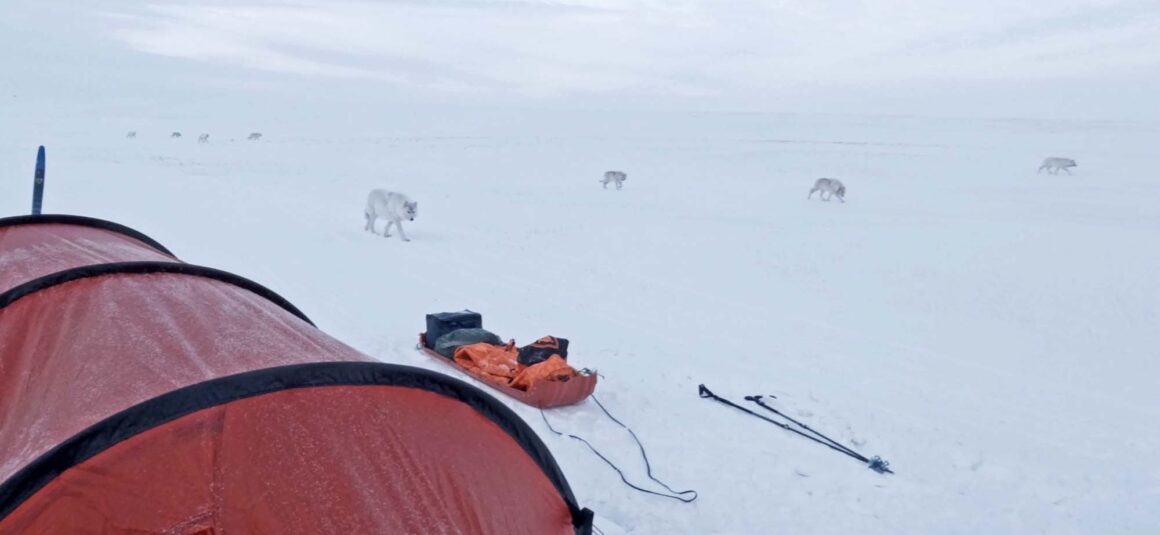
We’ve just finished setting up our first camp when the wolves appear. Ten large Arctic wolves are moving silently out of the whiteness, directly towards us.
“Do you think we need to be worried?” asks Ray.
“Don’t know,” I say, my pulse spiking. The wolves are all around us now.
“Shit, they’re huge.” Ray glances at me and asks, quietly, “Should I get my gun?”
“You could have it ready, but I think it’s fine.”
We’re both reading the same thing from their posture and pace. The wolves have spread out around us with the easy confidence of creatures who’ve never had to fear anything. One wolf stands just ten feet away. It doesn’t seem to make eye contact but rather looks through us as if focusing on something beyond. Its body language is calm, almost curious, completely in control.
“They’re clearly not scared of us,” I say.
“But we should be scared of them,” Ray laughs under his breath.
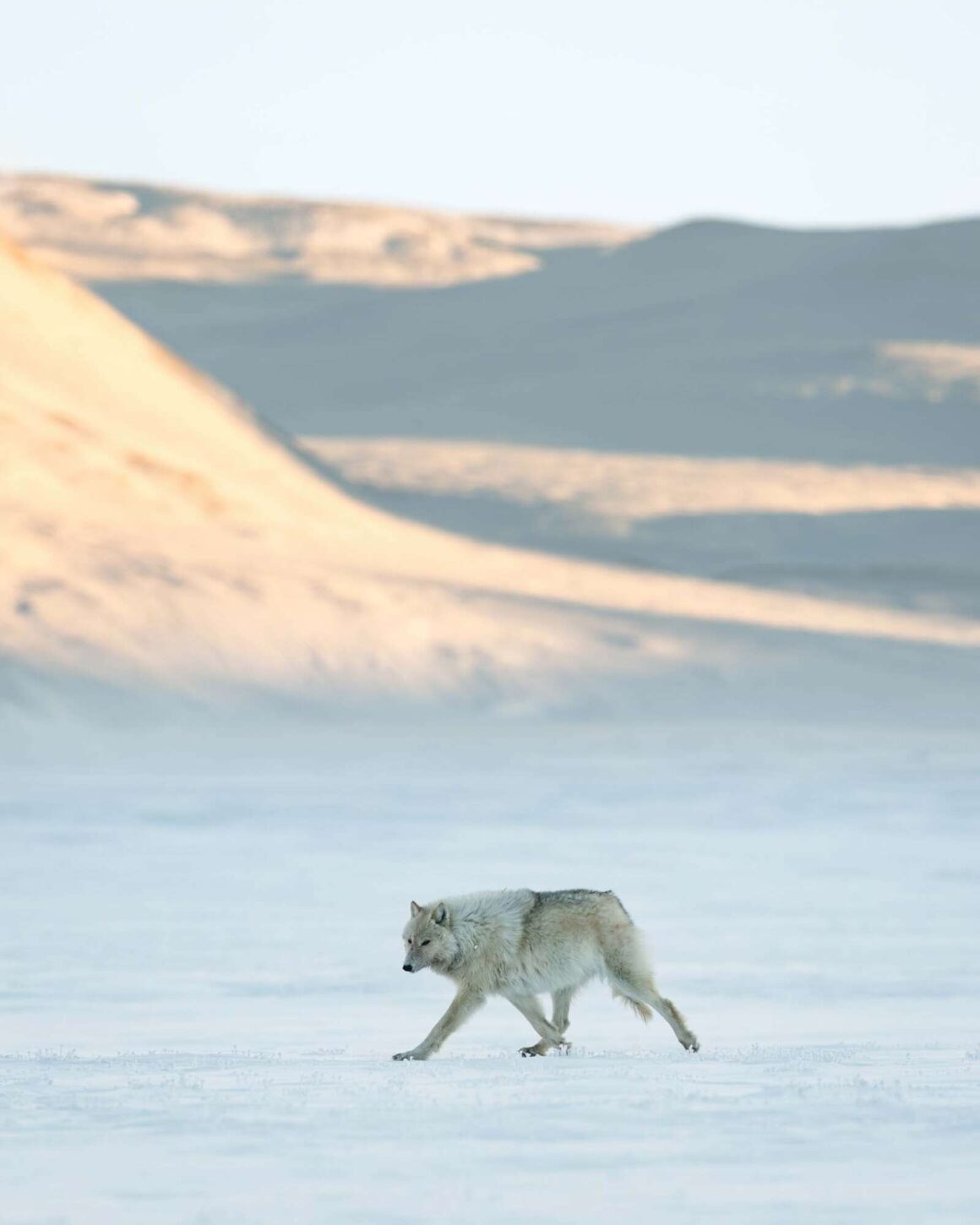
Here we are, two humans on a frozen island at the top of the world, surrounded by a pack of wolves that could dismantle us in seconds if they choose to. What’s strange isn’t the fear we feel, but the absence of it. We watch, calmly, as one by one they slowly lope out of view.
Ray Zahab and I are on Ellesmere Island in the Canadian High Arctic, a place so remote and untouched it feels closer to the moon than to mainland Canada. We left the Polar Environment Atmospheric Research Laboratory (PEARL) at the island’s Eureka research base only four hours earlier to begin our 500-kilometre ski traverse of the island. One of the northernmost inhabited places on Earth (though “inhabited” is a generous term), Eureka sits on the Fosheim Peninsula, a vast, wind-scoured wedge of land edged by frozen sea and carved by ancient glaciers. A small research team of eight rotates through the base, and when we arrived they each greeted us with their name, arrival date and the day they’d be leaving. It felt like hearing the beginning and end of a prison sentence.
Eureka sits on the Fosheim Peninsula, a vast, wind-scoured wedge of land edged by frozen sea and carved by ancient glaciers.
But this year, Eureka is busier than usual. A film crew led by producer Sophie Lanfear is tucked into a hardy little structure on the gravel ridge above the main research buildings. Lanfear—an award-winning wildlife filmmaker known for her work with David Attenborough on Our Planet—is here with her team to study and film the wolves. They’re betting that patience and perseverance will earn them rare footage of these Arctic ghosts in their winter environment.
Related content from ML:
“We’ve been searching for them for two weeks,” one of the crew told us before we left. “Tracks everywhere. No wolves.”
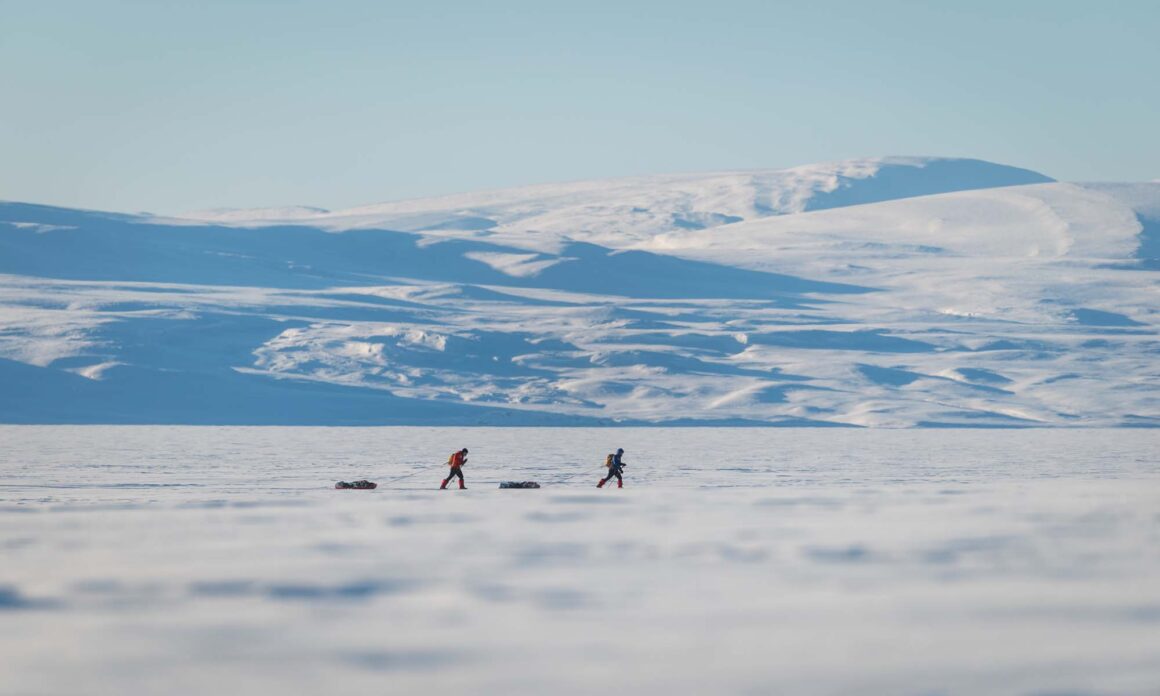
And yet within a few hours of clicking into our skis and leaving the safety of the station behind, the wolves have found us and delivered the first clear reminder of what we already knew: Out here, we’re not the ones in control. Not of the weather, not of the terrain, and certainly not of the wildlife.
Ray and I had come north at the coldest time of year to chase down a dream: a major traverse of Ellesmere Island from the weather station at Eureka to Grise Fiord, the northernmost community in Canada. For us, it was as much about curiosity as challenge. What will happen to us—physically, mentally, emotionally—when we spend weeks moving through a landscape this unforgiving? What do we learn about ourselves when there’s no real option to step off the ice, no cozy retreat, no exit ramp?
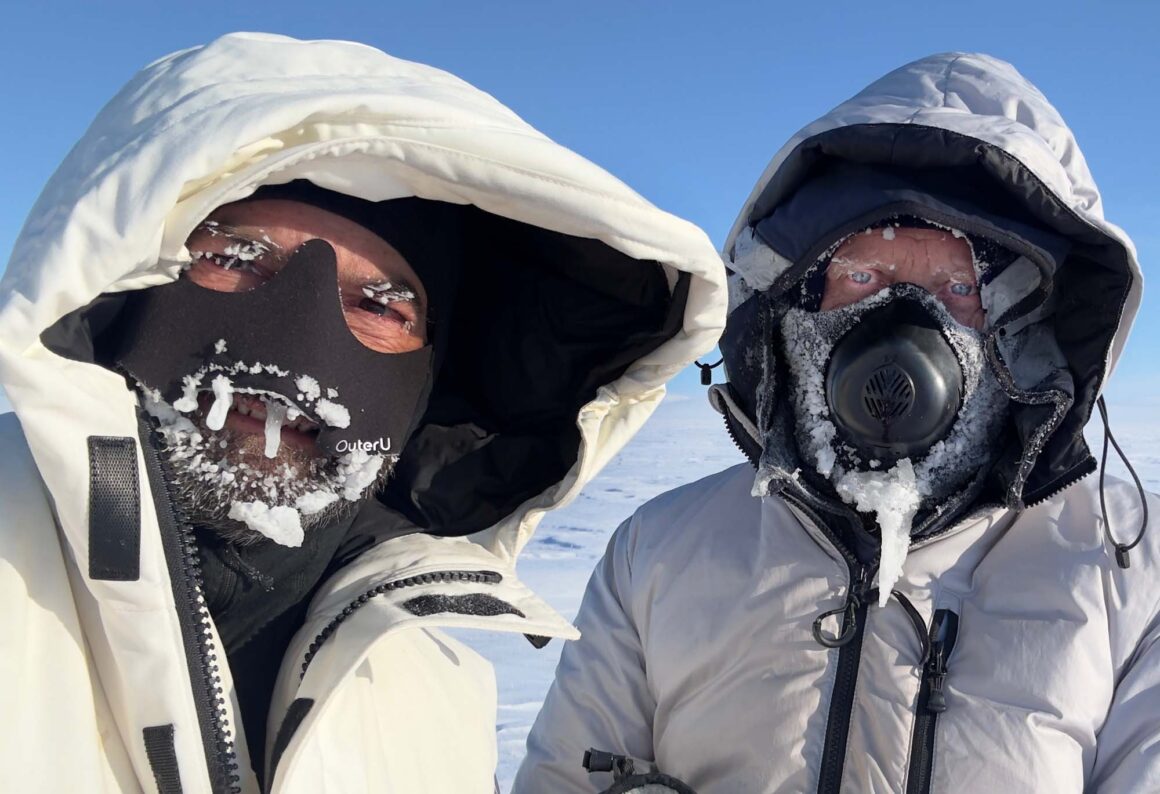
Most High Arctic expeditions begin in May and June—there’s still plenty of ice and snow, but the temperatures and conditions are far more forgiving. But moving through the Arctic when it has its guard down didn’t appeal to us; Ray and I wanted to experience it when it was at its most Arctic. The average daytime high in Eureka at this time of year is -36.6 C.

Reaching this moment—a pack of Arctic wolves greeting us then vanishing into the white—has taken three long years. In 2022, our first attempt at traversing Ellesmere ended in failure. After ten punishing days, we realized we’d misjudged both the environment and the extreme cold. Moving too slowly, we would have run out of fuel and food halfway across. Deeming the risk too high, we pulled the plug—a humbling call, but the right one. There had been a lot of media attention surrounding this attempt and the online trolling/commentator contingent were quick to suggest we were out of our depth and declare our planned winter journey impossible. Which only fueled our tenacity as Ray and I reminded ourselves we’d learned a lot and that next year would be different.
There had been a lot of media attention surrounding this attempt and the online trolling/commentator contingent were quick to suggest we were out of our depth and declare our planned winter journey impossible.
The next year, 2023, did indeed turn out to be different as Ray was diagnosed with blood cancer. Six rounds of chemotherapy took any expeditions off the table. Everything paused and our only focus was getting him healthy again. The idea of returning to Ellesmere never disappeared, and as Ray’s recovery progressed through the summer we told ourselves 2024 would be our year.
It wasn’t. Weeks before departure, our airline partner withdrew, leaving a $62,000 hole in the budget. Three years of trying, three years of coming up short. Walking away would have been easy, but we had never intended any of this trip to be easy.
In 2025, everything finally aligned. Healthy, supported and ready, Ray and I returned to Ellesmere—this time reversing our route plan and starting in Eureka to finish in Grise Fiord.
Getting to Eureka became an expedition of its own. With charter flights out of reach financially, we partnered with Ski-Doo/BRP, shipped machines north by sealift, and committed to reaching our starting point by snowmobile. The seven-day journey from Grise Fiord, led by local guide Terry Noah, proved to be one of the coldest snowmobile traverses ever attempted.
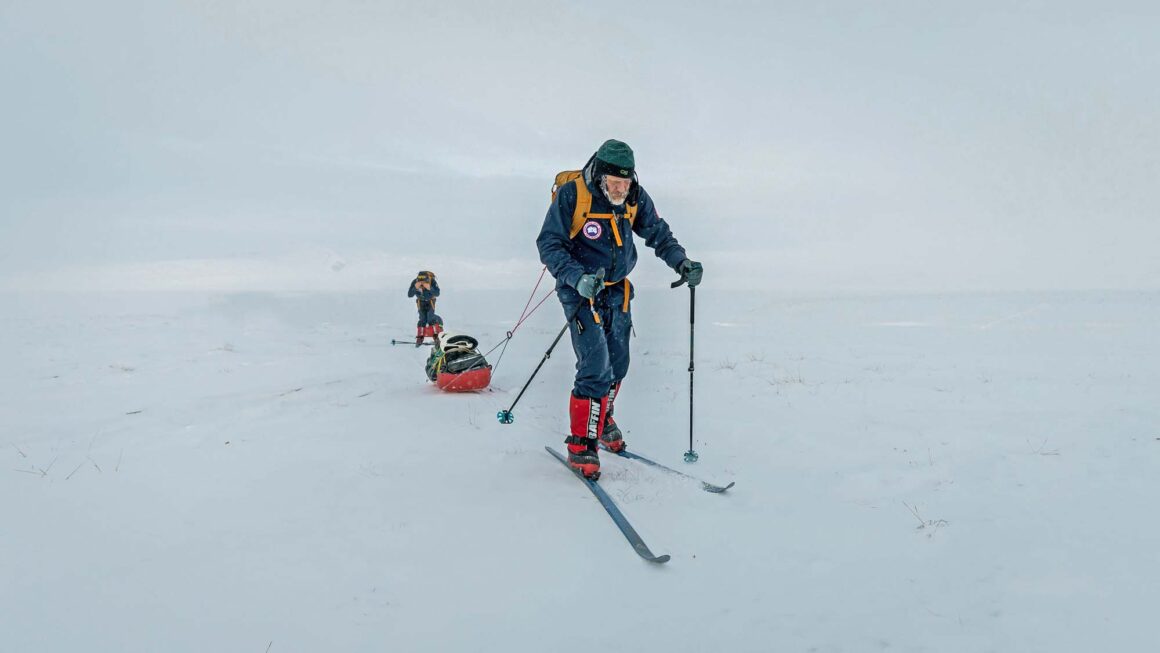
Once in Eureka, we swapped Ski-Doos for skis and began our long ski back, almost immediately running into those first wolves. Considering there are only an estimated 200 wolves on all of Ellesmere Island—a landmass the size of Great Britain—we were astonished by our luck. Little did we know our wolf encounters were only just beginning.
“Holy crap! Ray, we have visitors.”
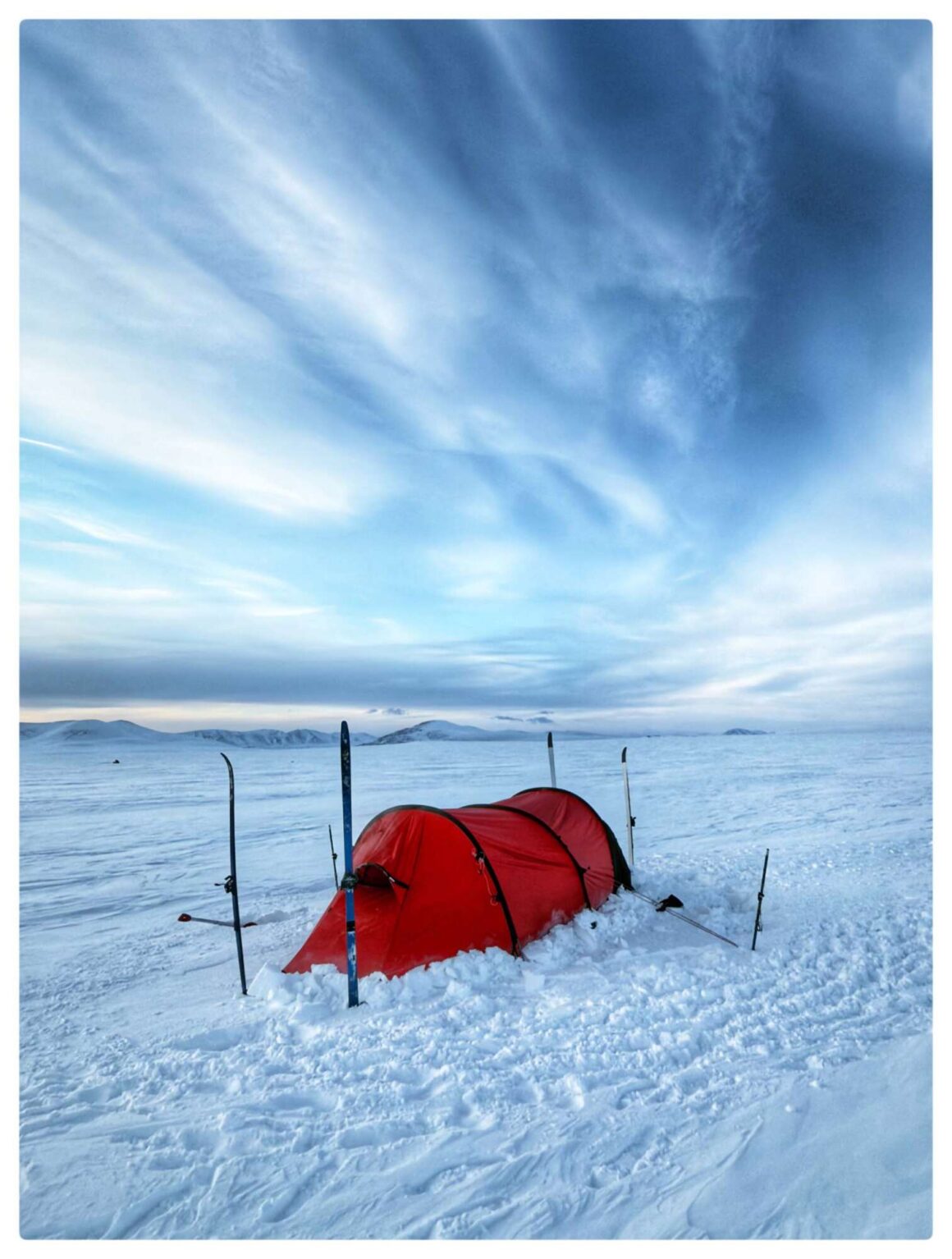
It’s day eight. After navigating the sea ice of “polar bear alley” on Eureka Sound, we’re camped on land again. Our tent sits on a small knoll in a wide valley. Ray is already in the tent firing up the stoves and I’m kneeling to tie a bungee to my sled when I look up to see four large wolves standing around me.
They’d arrived in complete silence and, as before, one is closer than the rest. Close enough that I can see the ice crystals clinging to its whiskers. It’s a brief visit; by the time Ray steps out of the tent, they’re already striding away. The next morning, however, another pack ambles by for a look.
Related content from ML:
Ellesmere’s Arctic wolves are one of the most isolated and least-disturbed wolf populations on earth. They travel in small family groups and cover huge distances—40 or 50 kms a day—in search of muskoxen and Arctic hare. They also shadow polar bears, scavenging the remains of seal kills. We often saw their tracks laid neatly inside bear prints across the ice.
What sets these wolves apart is not just where they live, but how they live. Unlike their southern relatives, Ellesmere wolves have never been hunted and have had almost no exposure to people. They occupy an ecological bubble where humans pose no threat, and generations of safety have produced animals that are unusually calm around us. Scientists in the 1980s and ‘90s described this phenomenon as “prey naïveté”—an inherited absence of fear simply because fear had never been required.
Their genetics tell the same story. Cut off from southern populations by sea ice and distance, Ellesmere’s wolves have maintained a remarkably intact lineage. Their compact ears, short muzzles, thick coats and massive furred paws are perfectly adapted for a world where extreme cold and scarcity is the norm. They are endurance animals, built to survive by staying in motion across an unforgiving world of snow and ice.
Most Arctic travelers who visit Ellesmere move along the sea ice that rings the island—it’s faster, flatter and far easier than crossing overland. But Ray and I are committed to an inland route—a true transect—which means we’re traveling where the wolves live. We aren’t finding them by chance; we’re passing through their world.
On day 12, camped in a valley at the base of the Svendsen Peninsula, our motion alarm goes off shortly after I zip the tent doors for the night. I always position the alarm facing the sleds, away from the tent, hoping a curious polar bear will trigger it before discovering us. I was outside a minute earlier and had seen nothing. Assuming a glitch, I unzip the door and find myself face to face with a huge wolf. I freeze, then slowly step out as nine wolves move around us. One stands very close and motionless while the others drift past.
Later, Terry Noah will explain what we’d seen in each of our encounters: The still wolf is the sentry—the one the rest of the pack watches. “They key off his body language,” Terry says. “If he’s relaxed, they’re relaxed. If he’s aggressive, then there’s trouble.”
This wolf stares at us calmly through yellow eyes ringed with frost. “He’s not the alpha,” Terry later continues. “He’s the young up-and-comer. The alpha is the one out front setting the pace.” And, sure enough, one wolf trots ahead without looking back, maintaining tempo for the group.
By the time we near Grise Fiord, encountering the wolves is no longer a surprise. We’ve been in their land for weeks, moving as they do—steady, efficient, always forward. On Ellesmere, you don’t stop.
Twenty-eight days after leaving Eureka, Ray and I ski the final stretch into Canada’s northernmost community. There’s no sense of conquest, only calm. Two human beings crossing an unforgiving island. After three years of setbacks and resolve, we reach our goal by following the simplest rule in the Arctic—and the most important one: Keep moving forward.

Check the ML Podcast!