A five-day journey in March across shifting Lake Huron ice saw an unsupported trio travel 56 kilometres from Tobermory to Manitoulin Island.

Three Saugeen Bruce Peninsula adventurers spent five days navigating one of the most unpredictable stretches of ice on the Great Lakes, traversing the Fathom Strait on foot and by paddle.
Scott Parent, Billy Shearer and Andrew Ryzebol left Tobermory on March 2, 2026 and arrived in South Baymouth on Manitoulin Island on March 6, moving through a constantly shifting landscape of pressure ridges, ice floes and open water. The team spent four days travelling and one day diving.
“It’s not like walking across a frozen lake,” Parent said. “The ice is always moving. You’re constantly making decisions.”
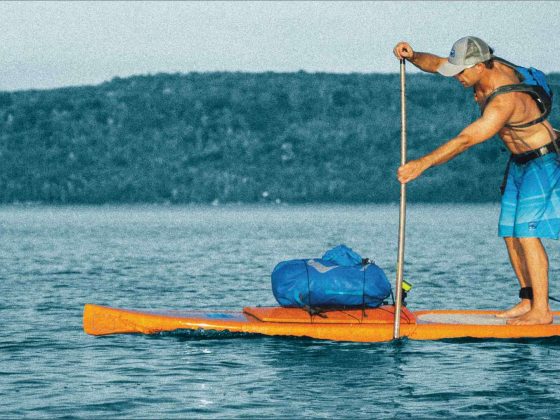
Each member of the team hauled roughly 200 pounds of gear, including winter camping equipment, safety systems and freediving gear. Their setup? Modified stand-up paddleboards mounted on ski sleds, allowing them to move across ice, then transition to paddling when the surface broke apart.
Related content from ML:
After completing roughly 30 km on foot, the remaining 26 km required paddling through open water and fragmented ice. In sections where the ice was too thin to walk and too thick to paddle, the group relied on breaking through by hand to keep moving.
“It’s a mix of problem-solving and patience,” Parent said. “There’s no straight line.” The environment added constant layers of risk. Parent acknowledged that fear is part of travelling in conditions like these.
“It’s a mix of problem-solving and patience. There’s no straight line.”
“There are definitely moments where it gets real,” he said, noting that moving through unstable ice requires focus more than anything else. “You manage it by paying attention and making good decisions.”

The team paused for a full day to freedive the wreck of the City of Cleveland, a steamship that sank in
1901 during a storm. Located roughly 30 km offshore near Perseverance Island, the site is difficult to access even in summer. They cut 50 holes in the ice before finding the wreck.
The crossing builds on more than a decade of refining what Parent calls “hardwater travel” systems. It’s a hybrid approach combining winter expedition travel with paddling. He employed a similar setup for a 2015 crossing of Georgian Bay.
A 2019 effort and another attempt earlier this year to cross the Fathom Strait both ended due to deteriorating conditions including gear failure. This time, their systems worked. “The Great Lakes behave more like an ocean than a lake,” Parent said. “Ice thickness alone doesn’t tell you much. It’s wind, current, structure. Everything is changing all the time.”
A more detailed, first-person account of the expedition by Parent will appear in an upcoming edition of ML. –Colin Field

Check the ML Podcast!