The (very) inside scoop on the AirNEST: a new way to camp

words :: Feet Banks
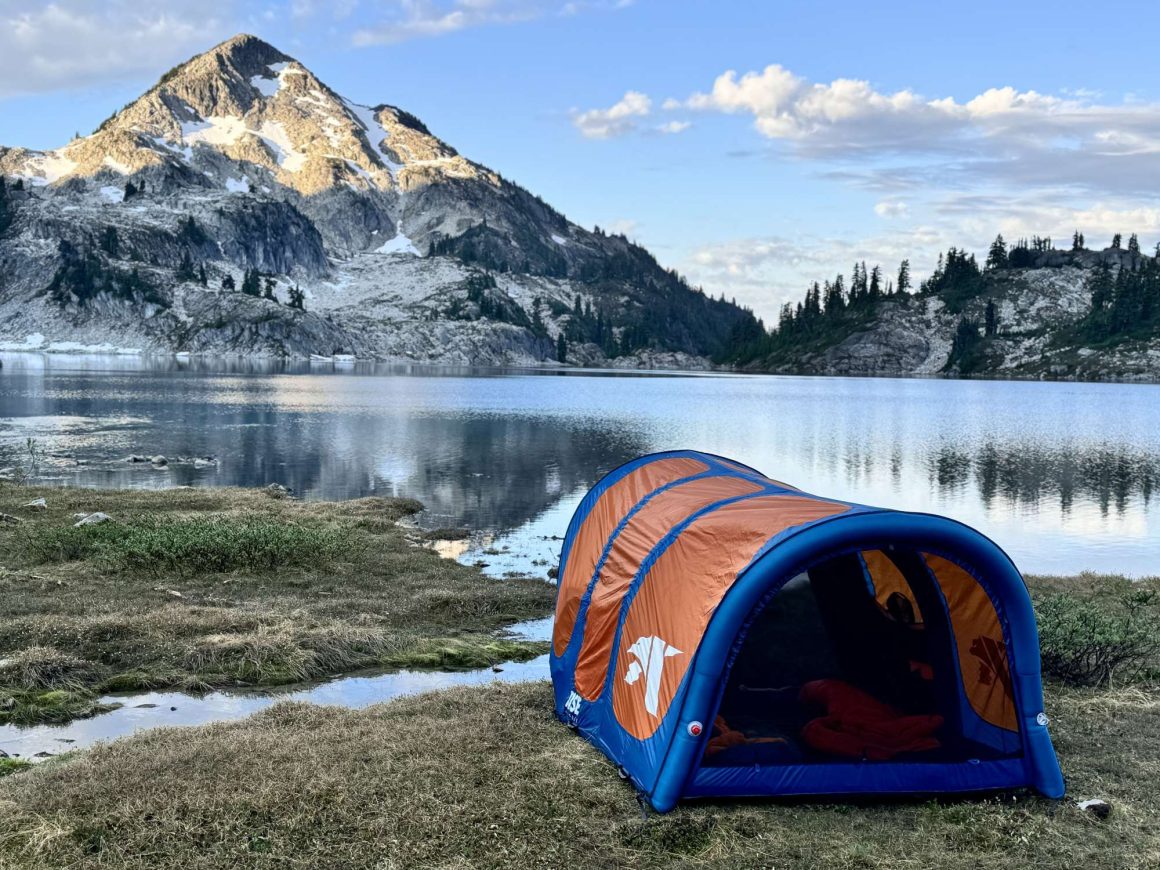
Before we really dig into this 3-season, 3-person, single-walled, standalone, inflatable AirNEST tent fully integrated outdoor shelter system, you need to know a few things:
Full Disclosure: This is insider baseball. The RISE tent was designed and invented by Todd Lawson, one of the publishers of Mountain Life and technically one of my employers. As well, I personally tested an early prototype of this tent and have been actively following along Todd’s RISE journey and helping him out when I can. So, this is probably not an unbiased piece of objective journalism. (But also, is anything these days?)
Having said that, while it’s important to support your friends I also like to bug the crap out of Todd at any given opportunity (he hates it when I call him “Toodles”) so I’m not here to shill bad product for him. If I didn’t think his tent and the story behind it was cool I’d simply refuse to do this piece. Good news is, I like the RISE tent, I’ve slept in one over a dozen times and it was awesome.
So, with that in mind, here’s Todd Lawson talking about his RISE AirNEST inflatable tent (with an integrated inflatable queen-sized mattress), which launched on Kickstarter today.
Feet Banks: Give me the elevator pitch. What do you tell people when they ask, what’s the deal with this thing?
Todd Lawson: I tell them I am creating the world’s first rapid-inflatable tent with a built-in mattress.
Feet Banks: A good product solves a problem. Tell me about the birth of this idea. What led you to think, “I need to improve my camping experience?”
Todd: I’m trying to solve two main problems. The time and hassle it takes to set up and take down a tent/mattress, and the crappy sleep people generally get when they go camping. That poor sleep quality is one of the biggest reasons people don’t go camping, or they go less than they used to when they were young and could pass out anywhere on anything.

The idea for RISE was born on the banks of BC’s Thompson River, on an annual SUP trip with a big crew. On that trip we are moving camp every day and one morning it was my turn to strike camp to deflate two single air mattresses. I rolled on them and lay on them to deflate. I folded them, then had to find the stuff sack and cram them in. Then it was onto the tent—fold it down, collect the poles, the pegs, roll it up, roll up the fly, cram it all in the sack. During all these tasks I could see other people just enjoying coffee by the river, and I started thinking there must be a better, simpler way to do this.
Feet Banks: I’ve been camping a couple years now in the same tent, and I don’t think too much about how long it takes to set up and take down. What does it offer people like me, who can get a tent up in under 5 minutes easy?
Todd: Here’s the main thing—it takes longer than you think. And a big part of that is the sleeping mattresses. I started timing our setups, after that moment on the Thompson. To put up a tent and inflate two sleeping mats by myself was taking about 22 minutes. With the RISE, you can get to camp and, even in the pouring rain, take out the tent and the pump and two minutes later it’s set up and you have a dry place to put all your gear while you focus on other chores like getting a fire going or enjoying the view or whatever. Then inflate the mattress at bedtime, less than two minutes and you are good to go. A person can do it alone; a young kid can do it.
Feet Banks: Kids love camping the most. Who is the ideal user for this tent?
Todd: The ideal user is a couple or a family with one young kid or a dog that wants to get the most out of what time they have to get out into nature. When they drive out of town and get to camp, instead of spending time on the setup they can spend that throwing a stick for the dog, or casting fishing lines, or hiking up to a viewpoint or collecting firewood or whatever they want to do. The tent is designed to get people out in nature faster so they can enjoy it longer.
Feet Banks: At 22 pounds packed weight with the battery-operated pump, it’s not really a backpackers’ tent, is it?
Todd: I deliberately chose to not go the ultralight backpacking route because there are lots of good solutions out there already. I know I am making an inflatable product, and I need people to be able to trust it—it needs to be sturdy and reliable. The underbelly has a 420D ripstop layer that’s puncture- and abrasion-proof. I designed the AirNEST for car camping, overlanding, boat/canoe/SUP trips. It’s for people who are camping a lot and setting up/striking camp almost daily. And for people who want to be comfortable.
Feet Banks: Design is everything. What inspired the design initially?
Todd: I was inspired by two things. One was a ribcage—everything inside a rib cage is protected. And the other is the catenary arch, one of the oldest architectural forms that’s been in use for thousands of years—it’s the one with a keystone at the top. I needed a strong structure so I looked at two of the strongest structures I could think of. Our ribs and an ancient and simple arch shape.
Feet Banks: Those of us who have been following along know this product has been almost five years in the making. A lot of tinkering, many prototypes. You had zero product design experience when you started. Talk about that journey: what were the most surprising moments?
Todd: I started with scissors and paper and tape. Just cut out my design to see if it would stand. Then I purchased a roll of TPU [thermoplastic polyurethane] that I could use an old clothes iron to heat weld pieces together. I traced out a flat pattern and started sealing the air chambers. I affixed an old air-mattress valve to it. This thing was about 2 feet long, but it took me hours and hours to cut out and seal the chambers and seal the valve in. But when I blew air in and it took shape and the front archway with the overhanging roofs came together, I knew it would work.

Then I took further inspiration from kiteboarding wings, which are built on the same principle—an inflatable skeleton. I knew if those can be manufactured to withstand the winds they do, then I’d be able to find someone to make my tent for me. I went online and found a bunch of manufacturers overseas. Ultimately, I went through five different manufacturers. Some of that was my own fault, not giving them proper specs on what exact materials I wanted (or not knowing exactly what I wanted). The first prototype weighed over 60 pounds, it was massive. The second one had a lot of problems with the stitching, the next manufacturer didn’t want to improve their first attempt and trim weight and size.
I personally have used ten different prototypes, but that iterative process was really important to me to find and address all the problems that could come up. The original design hasn’t changed much but I was surprised how much the details evolved—the guy-line loops, the zippers, stitching, the material. I think we have found the sweet spot now.
Feet Banks: What’s been the most rewarding part of the journey so far?
Todd: Seeing an idea that was just in my brain come to life in the real world has been crazy. Knowing in my heart this is gonna work, and then it does—that evolution from the dream realm to the physical realm is amazing to experience.

Also, testing the tent. My wife and daughter and I went on a big motorcycle trip from Ireland to India in 2022. So we got to test one of the prototypes in six countries across Europe and Africa. That gave me a really good feel for things. When you have a piece of gear and you use it over and over, that gives you an honest feel for the product. We spent a lot of time under the overhanging roof in the shade, making coffee or reading. We loved how big the doors were. I’ve also enjoyed sharing it all as things have come together too. My whole idea was to bring people along for the ride and show everything—the good, bad and the ugly.
Feet Banks: The electric, battery-powered pump is an important part; talk about that.
Todd: The pump was one of my biggest mistakes and it ended up costing me a lot of money. Inflatable tents aren’t new but there was nothing out there that looked or performed how I wanted. And a portable mechanized pump was important to me. Originally, I tried to develop my own pump. I wanted to get away from the manual up-and-down SUP pump or the ones you need to plug into your car. There was nothing on the market at that time that suited my needs, so I tried to invent one. I was looking at avalanche air bags for their rapid-inflation properties.
But those work because they just need to create volume to fill a big rectangular bag. With the tent, with a number of corners in the air compartment, I needed volume and pressure. I hired a company, and they were making good progress, but then I saw these pumps come online that were exactly what I needed—battery operated, pumps to 20PSI, USB-chargeable, acts as a battery bank as well—so I pivoted quickly and got out of the pump business. The Rise AirNEST does come with a manual pump, like a paddleboard pump style, but a bit smaller.

Feet Banks: I’m interested in how the tent breathes or vents. Traditionally, the issue with single-walled tents has been ventilation—how do you get the moisture from 2-3 people breathing and rolling around in there to escape the tent? I know on a particularly cold night in prototype 1, I woke up with frost and condensation falling on me from the ceiling. How did you fix that?
Todd: You flagged that early on and I knew it would be a main problem to address. I wanted single-wall because of the simplicity: tent flies are another mountain of fabric to deal with and can be a nightmare at 2 a.m. when the rain starts. The AirNEST breathes because I have those two giant doors on each end underneath two overhanging roofs, so I crack those doors a foot down from the top on each end and it breaths well. The nice thing is the overhang at the front is three feet, and one foot at the back, so even if it is raining, no water is getting in and the mesh keeps out the bugs but the moisture from inside can escape. I have not done winter testing at all. This is a three-season tent.
Feet Banks: Your low-budget, guerilla marketing for this product recently saw a big win. Tell us about that.
Todd: To me it was important to be transparent with the entire process, I think people appreciate that level of authenticity when they’ve been along for the ride the whole way. It was not easy to put myself and my failures out there. One time we were in Bulgaria, and I was so stoked to test the newest prototype…and it went flat in 24 hours. So I shared a photo of this deflated tent that looked pathetic, but that is how I learned about reinforcing all the seams and the valve and about failure points. I think just doing things and showing people the wins and the losses helps with credibility.
And then recently someone commented, “that thing will blow away in two seconds of slight breeze,” and I thought, Will it? Let’s see. I don’t have a wind tunnel, but my friend has a big long flatbed snowmobile trailer so we set the tent up and nailed down the guy lines and the peg loops and hit the highway on one of the rainiest days of the fall so far. We got the truck up to 90 km/hour and the tent held just fine. That video and story got hundreds of thousands of impressions on LinkedIn and tonnes of comments. I got a lot of praise for the “show don’t tell” approach to answering that inquiry. And now I know it performs well in the wind if you properly secure it.
Feet Banks: How has the feedback been in general? We live around and work with some of the most discerning outdoorsy types on the planet.
Todd: The feedback has been pretty amazing. People seem to understand the problems I am trying to solve. We get stopped a lot at public campgrounds a lot. And a lot of women are calling it a “very sexy” tent, which is funny because at one point early on I considered calling it the LoveNEST. I know there is no such thing as a “perfect” tent for everything and everyone, and I still learn something every time I go out camping. I’m just striving for excellence with what we are bringing people who want a simple, fast tent for car camping, overlanding, or trips on the water.
Feet Banks: After all these trials and failures and successes, you are about to launch to the public. Do you still love camping as much as when you started, or more?
Todd: More. I’ve always loved camping, and I know what benefits it has brought to me and my family. Those important times in nature where you connect just by being there—you connect with the landscape and you connect with each other. And my camping experience is better with this tent. If it’s raining or really buggy, I just deflate the mattress and four people can sit in chairs inside the tent and play cards or whatever. I’m sleeping better on the giant mattress, and—as I wished for—I am spending way less time on chores and more time enjoying myself. Camping isn’t a race or a contest, but time matters. Now I am spending more time doing things I like to do and less time muttering under my breath while trying to ensure I get the door zippers lined up while trying to attach a tent fly in a rain squall. In the dark. In my underwear. There’s a better way, I promise.


Check the ML Podcast!