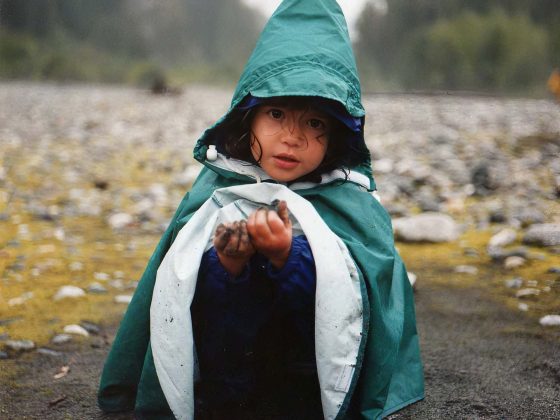
What’s your relationship to nature?
This is the central question Fjällräven asks the artists selected for its Kånken Art project. The canvas on which to depict this relationship includes iconic Fjällräven backpacks (“Kånken” means “to carry” in Swedish), shirts and bandanas. This year Fjällräven collaborated with Charlene Johnny, a Coast Salish (Quw’utsun’) artist of the Quw’utsun Tribes of Duncan, BC to create a Kånken that expresses Charlene’s sacred ancestral relationship with nature.

Here’s a Q&A with Charlene Johnny:
Q: Can you tell us a bit about yourself and your journey as an artist?
A: I’m a Cowichan artist from the Quw’utsun Valley, known as Duncan, BC. I was adopted and given a Kwatkwiutl name, Ganadzi from my Kwakwakwak family. When I was 10, I moved and was raised on Musqueam, Tseilwatuth and Squamish Territory, known as Vancouver. I continue to travel back and forth between the mainland and the island and maintain my connections to the communities at large.
I started creating art as a child, and apprenticed under other various First Nations artists, before focusing on my own journey in 2013. I won a couple of art grants from the YVR Art Foundation. From there I attended Native Education College in 2018 for a jewelry-making program. I started painting murals at the same time, volunteering my time to peers in order to learn the process. Since then, I have painted a couple dozen murals across metro Vancouver and in Duncan.

Q: How would you describe the style of your artwork and where does it come from?
A: Being a Quw’utsun Slheni’ (Cowichan woman) I use my inherent ancestral right to practice Coast Salish art. This is one of many styles of Indigenous art along the Pacific Northwest coast that belong to different nations/tribes, and Cowichans in the southwest coast of BC fall under an introduced umbrella term, known as Coast Salish. Our style of art primarily uses circles, crescents and trigons, which is distinctively different from our northern relatives.
Q: What mediums do you typically work with?
A: I paint murals mostly, though I carve silver and copper jewelry in addition to using technology to create graphic art using Coast Salish design techniques.
Q: What were your initial thoughts when you were asked to work with Fjällräven?
A: I was very surprised when I first connected with Fjällräven. A store manager had gotten in touch with me via Instagram to come into the Kitsilano store location to paint backpacks and donate the proceeds to charity. My relationship grew from there when I was invited to be a store guide. As I got to know the brand, I had a dream and a vision to become a Kånken artist, little did I know that dream would come to reality.
Related content from ML:
Q: And how did you approach the Kånken Art project? What inspired the design elements?
A: I wanted to honor my ancestors and community with my art practice by bringing a design back to life that was initially carved into a spindle whorl over 100 years ago by my ancestors. We always used natural materials of the land to create everyday practical objects, with cedar being a primary resource for items such as hats, paddles, canoes, regalia, spindle whorls, masks, poles, baskets and combs. I love seeing the art that my ancestors chose to adorn these everyday objects with. This was the inspiration.
The design featured on the backpacks is based on a very old Quw’utsun spindle whorl design. Spindle whorls were carved out of cedar and used to spin wool to weave and knit into blankets and clothing. In the pre-contact era, we used the wool from the now-extinct Salish wooly dog. Post-contact our people started using wool from sheep, an introduced species. The colours from the grey scale bag are inspired by various shades of wool, with brown paying homage to cedar, blue mirroring the colour of trade beads, and red representing the colour of one of our medicines. Even the straps feature a weaving pattern.

Q: How does your Indigenous heritage influence all your artistic expressions?
A: As an Indigenous person, my whole identity and what I create is in honor of my Quw’utsun Heritage. I am learning our language through titling my works of art in our language. It is important for me to spend time in my community learning from our Sulhween (elders) in order to share our history and keep our culture alive for our Musimhw (people), but more importantly for our ‘xe ‘xe smuneem (sacred children).
Q: Nature plays a significant role in all your work. Can you explain why?
A: All our art and everyday objects were created with items from nature and are inspired by every living being out in nature. Everything in nature has a spirit, and everything I create using nature as motifs honours each of their spirits. Whether I am drawing our celestial relatives like the sun or the moon, or I am painting eagles or ravens, I honour my ancestors and the spirit and life forces that flow through all of us. We do not see ourselves as separate from the land, we all have a shared living spirit, so we must honor and protect all beings of life as if they are our relatives.

Q: What impact do you hope your artistic contributions will have on the broader community and the causes you support?
A: Taking care of the land and respecting the land and its history while keeping the art and stories of my people relevant is my priority. If I can shed some light on our history and inspire others to take care of their surroundings, then I will consider my goal achieved. I always hear our elders say Nutsamaat shqualuwen. The loose translation for that is ‘one heart one mind.’ We have more in common than we have differences, so we need to come together and learn from one another and take care of everyone and all living beings as if they are our relatives, because they are.
“Whether I am drawing our celestial relatives like the sun or the moon, or I am painting eagles or ravens, I honour my ancestors and the spirit and life forces that flow through all of us.“
Q: This year the Arctic Fox Initiative will support The Stqeeye’ Learning Society. What made you choose this organization?
A: When it came to selecting the organization to work alongside, I was so excited to bring Stqeeye’ Learning Society in without hesitation. This organization is based in one of our traditional villages, Xwaaqw’um (Burgoyne Bay, Salt Spring Island.) I am really excited to support the work that they do, not only because we share kinship in our territory, but also because I share the same values as Stqeeye’ in preserving the land and enabling our youth and elders to access the land, learn and preserve the land and nature. Supporting the good work that they do, is supporting our society as a whole.
Q: What do you hope the effect will be of your Kånken Art?
A: I hope that people learn about not only Quw’utsun people, but how diverse Indigenous people of North America are. We want to work together and use our inherent rights to preserve the land for future generations.
Q&A supplied by Fjällräven.

Check the ML Podcast!