86
MOUNTAINLIFE
SUMMER2016
The flowof abike, finding
itsquirks, studying the
different designsand
knowing thatwhat I’m
doing isgoing togive
someonemoreenjoyment.
in Motion, saw that I was mechanically inclined
and knew how to foster that. He showedme
all the tricks: chasing and facing the lug shells
and head tube, you used to have to ream it to
make sure the cups were parallel. Things are
done at the factory now, but back then, the
road frames would come in a crate and you’d
order all the components, lace the wheels, build
the wheelset. My buddy was up front selling
them and I was in the back building them.
Almost every bike was custom back then.”
Taking his wages in bike parts to keep his
passion rolling, Fraser continued fixing bikes
all the way through college (three diplomas
in four years), while also trying his hand at
water taxi driving, stone masonry, adventure
racing, running and training sled dogs, and tree
planting, all which gave him a taste of British
Columbia and the biking and rock climbing
potential of the Coast Mountains.
“I came out again to work as a mechanic for
the first BC Bike race,” Fraser says, alluding to
the epic multi-stage weeklong mountain bike
race/ride on Vancouver Island, the North Shore,
Sunshine Coast, Squamish andWhistler. “That
first year was such a party. We rode every day,
fixed bikes and then partied. As the race got
popular, the workload kept doubling and it
became a heads down crankfest.”
TheWhistler after party for that first completed
BC Bike Race also introduced Fraser to his
future wife (proof that true love can be found
at Tommy Africa’s). After accepting the job
as headmechanic for the race in 2009 (or
2010), Fraser (nowwith a wife and young son)
migrated west permanently and ended up in
Squamish, cranking away in bike shops and
living the dream, almost.
“The bike scene here is insane and I can work
as a mechanic 12 months a year, but as my
son grew up, I started feeling like ‘why am I
working all afternoon making money just to
pay someone to take care of my kid until I am
finished work?’”
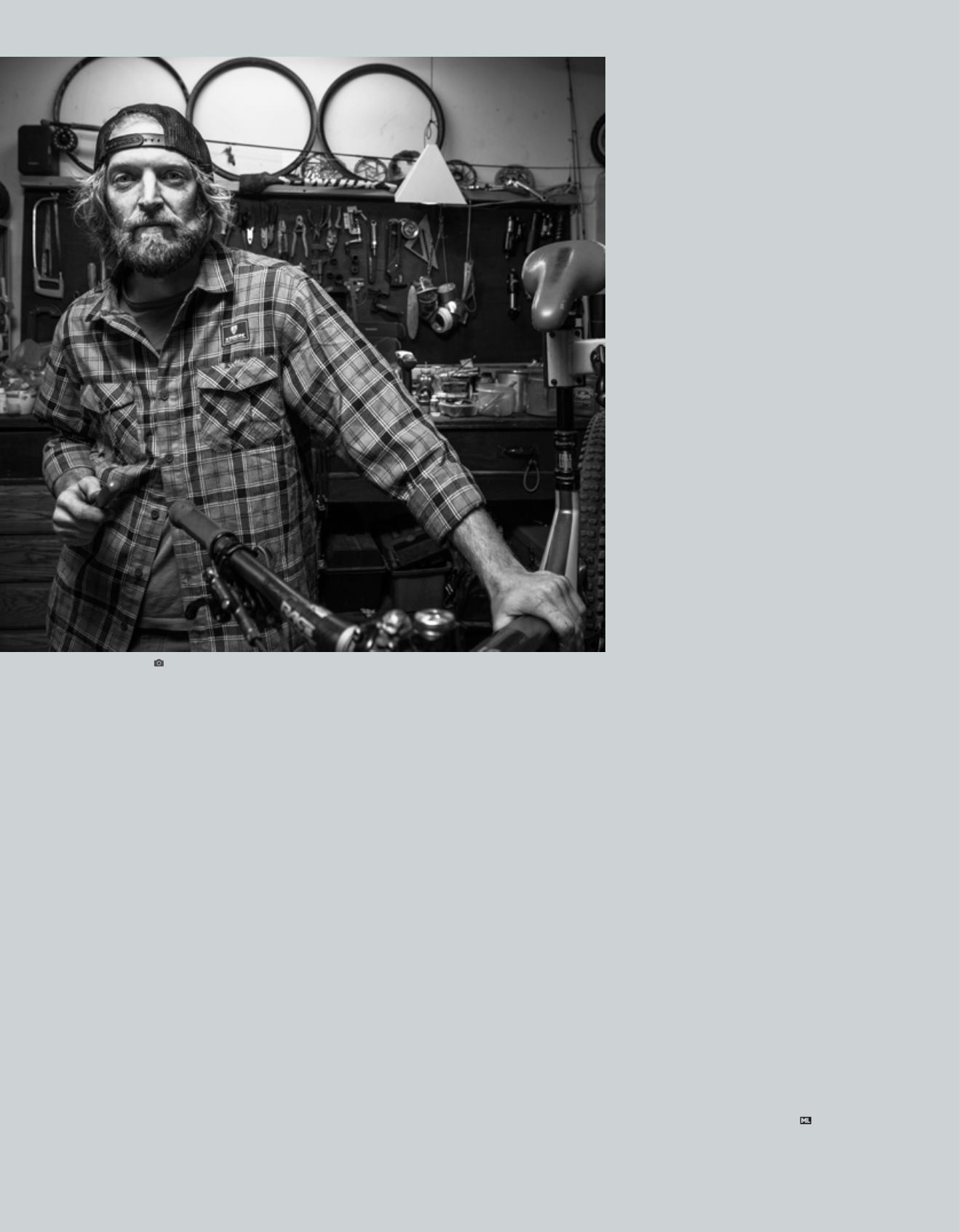
The math didn’t add up, so Fraser retired from
the nine-to-five and currently pulls wrenches
in his garage for friends, rental companies or
shops that need a hand building big orders. The
move meant more family time and the freedom
to travel and work for events andmovie shoots.
Most importantly, it provided a chance to get
even deeper into the local bike community.
“Wrenching out of the garage keeps me in tune
and keeps me in and out of all the local shops,”
he says. “That is themost important. It is a
tricky time for bike shops, but people need to
understand that you can get stuff online, but the
knowledge in your local shop is where the real
value is. People who love bikes, who know how
tomake things last and what is compatible.”
That love of bikes is the backbone of a healthy
industry. It’s a love that can be learned, but
the best mechanics are almost like wizards or
alchemists—the end product becomes more
than the sum of all those interconnecting parts.
“What I love about working on bikes is the
flow,” Fraser says. “The flow of a bike, finding
its quirks, studying the different designs and
knowing that what I’m doing is going to give
someone more enjoyment. It’s the process of
tinkering out there—my dad was an engineer,
my grandfather was a nuclear physicist and
while bike mechanics certainly isn’t rocket
science, I feel like that curiosity to explore
the way things work is definitely part of what
drives me. And I love being out in the garage
with my own son, just working on whatever he
wants to do, using tools and building stuff. It’s
like man Lego, and this way I get to ride and
spendmore time with my kid.”
Mixingup themedicine. MARKGRIBBON


