WINTER2017
MLBLUE
103
G
rowth
after
J
ozo
In1969, after a decade ofmajor expansionof
lifts, trails and lodges, Jozonamedhis feature
trail,Tranquillity, (now servedby the Silver
BulletChair), after the site of themoon landing.
Two years before Jozo’s death in a car accident,
thismarked the emergence of BlueMountain
asOntario’s leading ski resort.Uponhis death
in1971he left his successorswith a powerful
business, but one that reliedmainlyonwinter.
GordCanning, Bill Skelton and the topmanagers,
backedby the family, and in1999 joinedby
Intrawest, built on the foundations and retained
muchof the culture that Jozohad instilled.
Technologyhas been transformative and a great
enabler. Jozohaddugout reservoirs and installed
pipes for snowmakingon theAppleBowl, but the
systemdeveloped in later yearswas amassive one,
reinforcedbywater lines extending intoGeorgian
Bay. Backhoes, bulldozers and evenhelicopters
allowedmore rapid and efficient installationof lifts
and facilities.
In1954Bill Skelton, who later became area
manager, and I spent the goodpart of a summer
digging irrigationditches andputting indrainage
tiles under theNorthArea parking lot.Today a job
like this couldbe done in a fewdayswithdump
trucks and earthmovingmachines.
Technologyhas improved the comfort of thewinter
experience andmade it easier to appreciate Jozo’s
sloganof loving thewinter. In the1940s and ‘50s
Jozowouldprovide aday ticket to skiers, usually
students,whowould tramp thehill in themorning
in return for free lift riding in the afternoon.Today
the resort relies on its $3,000,000grooming fleet.
The town and the resort plough roads andparking
lotsmuchmore thoroughly than in Jozo’s timebut
if there is drifting snow it canbe easilymastered
by theubiquitous SUVs that bring skiers to the
mountain. Car company advertising encourages
winter adventure in these vehicles. Subaru (current
sponsor ofBlueMountain) andother companies
encouragedrivers not to cower indoorswhen
a snowstormhits. In recent ski seasonsBlue
Mountain ran a “Be aWinterWarrior”promotion.
Jozowouldhave applauded thesemessages.
Successive generations of skiers have enjoyed endless
improvements in their equipment. In the1940s
fixed-toe andheelpieces causedmany abroken
ankle. Leather boots gotwet in slush anddidnot
provide great support unless reinforcedby long
leather strapping,which also increased thedanger.
Thewisewouldglancebehind them andbe aware
of runaway skis.The1950s and '60s broughtmetal
skis (later tobe replacedby evenbetter fibreglass
ones), firmplasticboots, safetybindings, safety
straps and ski brakes. It took time toperfect the
equipment.Near the endof a slalom race, Iwas
within tenmetres of the finishwhenmynew
Marker bindings releasedwithout cause and I took
ahumiliating faceplant.Thiswouldnot happen
todaywhen themechanisms areprecisely calibrated.
My laminatedwooden racing skis (used for both
slalom anddownhill)were advanced for the timebut
their 215cm length slowedyoudown in slalomgates
andwouldhavebeen trouncedby today’s fibreglass
models.Despite their vastly shorter length they
providegreater stability, float throughpowder snow,
but alsohold an edgeon iceorhardpack.
Earlyparkas andpants couldbe stylish, but in
order tobewarm anddry there had tobe layers of
underwear and sweaters andnot even that always
sufficed.Mitts couldbe soaked and tornon rope
tows.Today’s jackets canwick awaydampness and
some even containbattery-poweredwarmers in the
pockets.Heated ski boots cankeep the feetwarm;
Gore-Tex gloves do the same for fingers; and there
are greatmasks and goggles that protect a skier’s
face from frostbite.Thewinter outfits are so cozy
that they givenewmeaning to theNorwegian
saying: “There is no such thing as badweather, just
thewrong clothing.”
JozoWeider turneda farmer’s barn into a lodge;
he grew food on themountainandbuilt chairlifts out of
scrap steel in the back yard of our home farm, located
between theBay and theMountain.
ABOVE, L-R
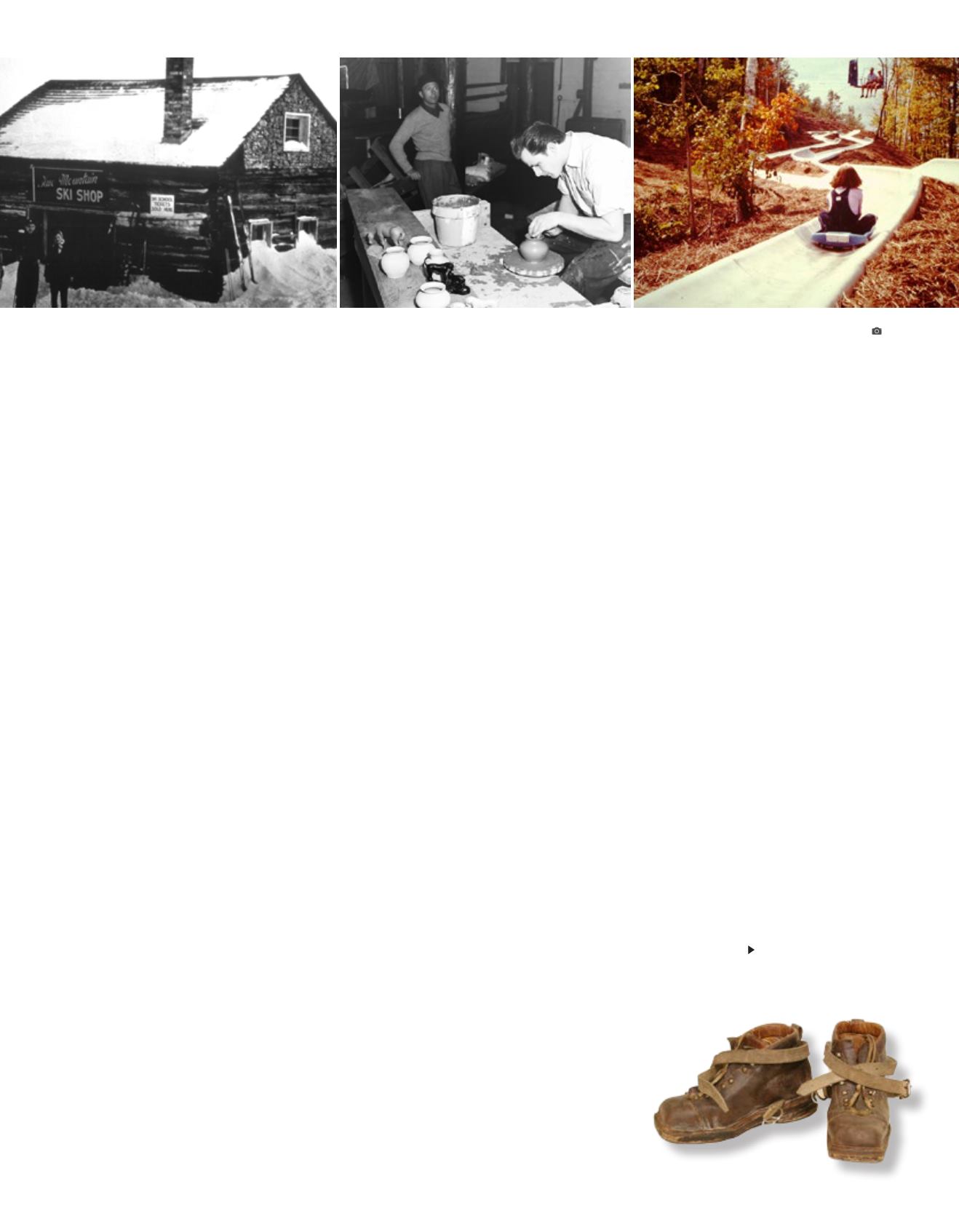
Sheepbarn converted into ski shop, c. 1953;DenisTupymakingpottery in the Ski Barn in the late '50swhile
JozoWeider looks on; Jozo's visionof the four-season resort comes topasswithTheGreat SlideRide, 1978. BMR


