42
MLBLUE
SPRING2017
Myles was familiar with loons as a cottage creature but had never been
so close. Determined to get a picture, we’d followedmany on the water;
sometimes they let us approach, other times not somuch. In either case,
with the wide-angle lenses and shutter delay of most digital point-
and-shoots, it was hard to get a solid image. Indeedmost of our shots
were so vague they could be submitted to some cryptozoology site as
evidence of an Algonquin lake monster. But tracking these birds on the
water isn’t easy; their movements are, at least to anyone who isn’t a
loon biologist, notoriously random: when a loon dives you have no clue
if it will pop up next to you or half a kilometre away; their whole body
may surface or just their head and neck; sometimes, when they feel
particularly threatened, only their beak appears, vertically like a snorkel;
two loons diving together may come up far apart or vice versa; loons
may display no interest in you whatsoever or be obviously curious. But
whatever they do, as McPhee notes, they will laugh it off in characteristic
style, as if the joke of their unpredictability is on the observer.
If the laugh were human, it would be a laugh of the deeply
insane. The bird’s lower jaw opens and claps shut five times
in each laugh. If, fromwhere you watch, he is swimming in
silhouette, you can count themovements of the jaw. He can
laugh two or three ways, and he can also squeal like a puppy.
But it is with another sound—a long cry in the still of the
night—that the loon authenticates the northern lake. The cry is
made with the neck stretched forward, and it is a sound that
seems to have come up a tube from an unimaginably deep
source—hardly from a floating bird. It is a high, resonant, single
unvaried tone that fades at the end toward a lower register. It
has caused panic, because it has beenmistaken for the cry of
a wolf, but it is far too ghostly for that. It is detached from the
earth. The Crees believed that it was the cry of a dead warrior
forbidden entry to heaven. The Chipewyans heard it as an
augury of death. Whatever it may portend, it is the predominant
sound in this country. Every time the loon cry comes, it sketches
its own surroundings—a remote lake under stars so bright they
whiten clouds, a horizon jagged with spruce.
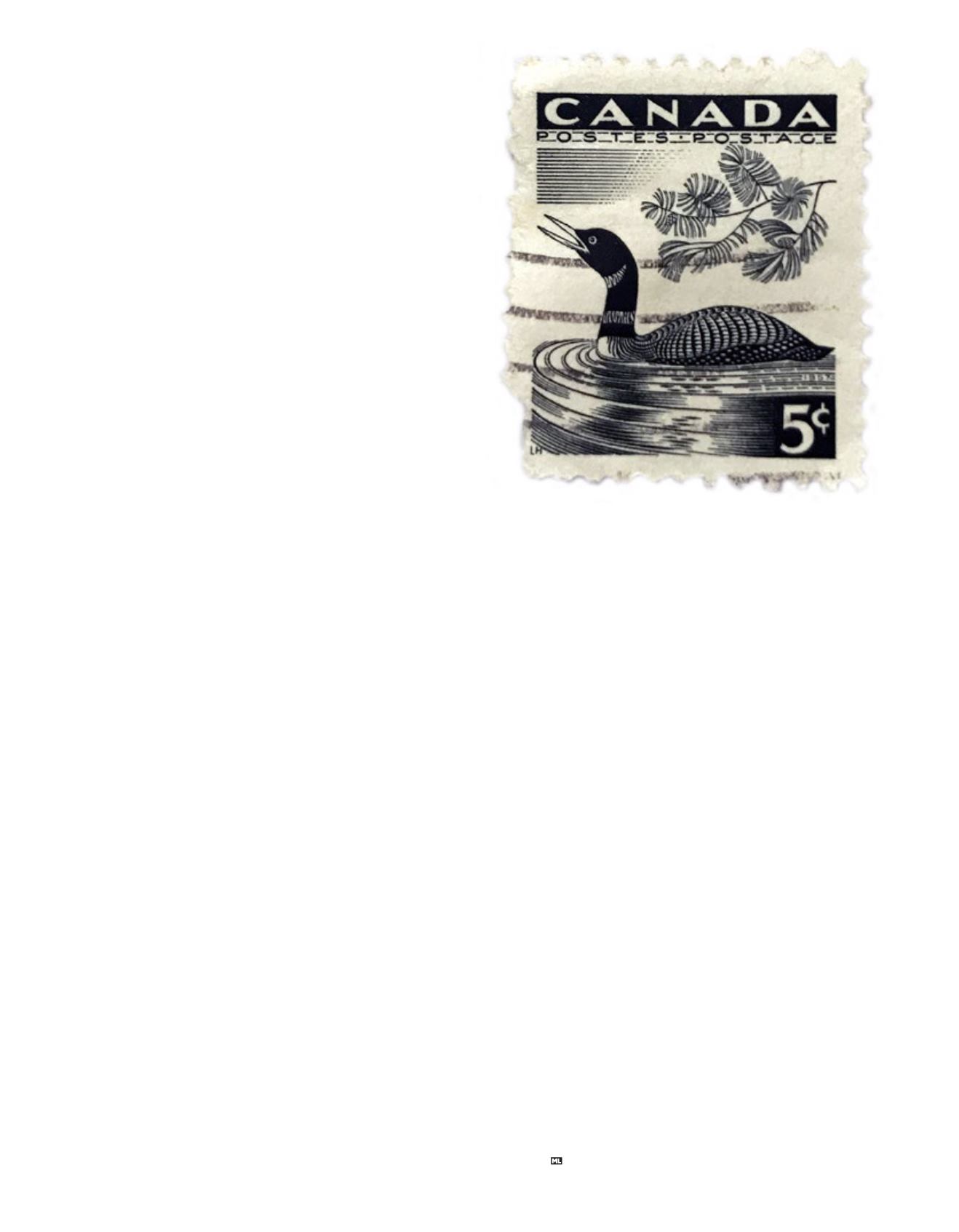
The loon indeed authenticates a northern lake, and in so doing has, to
some extent, authenticated an entire country. This, I told Myles, was the
reason Canada’s bronze-plated one-dollar coin with a loon emblazoned
on the reverse (Queen Lizzy II on the obverse, of course)—which should,
by rights, really just be called “a dollar”—quickly became the “Loonie”
after its 1987 introduction. Loonie was so widely recognized that the
Royal Canadian Mint bought rights to the name in 2006, making it the
official label for Canada’s currency in global financial markets. And the
backstory is even better: similar to Canada’s previous silver dollar, the
new coin was meant to have a voyageur theme, but the master dies were
lost in transit to the mint and a different design was needed stat in order
to avoid possible counterfeiting. So ubiquitous was the term Loonie that
Canada’s two-dollar coin—which dropped in 1996 and has a polar bear
on the back—was instantly known by the portmanteau “Toonie.”
Yes, people seem to genuinely dig these crazy birds. They’re mascot
worthy. If the souvenir industry in this country weren’t already so
crowded, the loon, with the right management team, could dethrone
beer, bacon, beaver, maple leaf, donut, inukshuk—Mounties for gawd’s
sake. Just for being certifiable. How Canadian! I might have been ranting
a bit to Myles but I was making a point.
—What do you think of all
that
? I’d said.
She’d looked up from her crossword. It seemed she’d been listening, but
apparently that had stopped when she started thinking.
—How far can loons see underwater?
—Further than us. Further than fish.
—And above water.
—Pretty far, I guess.
—At night, too?
—Probably not.
—Then what are they all doing out there?
As if in a ham-fisted attempt to provide their own explanation, a strong
commotion broke out on the water. Splashing and wing-flapping.
Desperate ululation.
—Who cares what you think?, I yell out of the tent for fun. You’re just a
bunch of dumb birds!
They laugh.
Loons’discomfortwith terra firma, onwhich
theyspendperilously little time—and thenonly
duringnestingseason—is the flipsideof an
exquisiteadaptation to lake living.


