44
MLBLUE
FALL2016
type aims to detect new arrivals. In both cases,
Kimoto deploys small traps baited with insect
pheromones (sexual attractants) or host-
plant volatiles (e.g., the pine “scent” familiar
to humans represents dozens or hundreds of
different chemical odours to an insect). He
spends plenty of time searching forests close to
port areas, as well as their industrial zones. “We
can’t confiscatematerial,” he says of high-risk
wood packaging, “but if a company has insects
emerging from something, they’ll usually call us.”
Oceanic shipping and air freight are
the
major
pathways of insect introductions worldwide,
and wooden frames, crates, and palettes used
to protect everything from glass windows to
electronics are the number one vector for
nonnative forest pests. The wood is supposed
to be pre-treated (typically fumigated) to
international standards, but often isn’t, so
Kimoto still sees plenty of foreign insects
applying for Canadian citizenship. For example,
beginning in the nineties, alert warehouse staff
in various states and provinces intercepted
larvae and emergent adults of ALHB on
packages arriving fromAsia, but the species
nevertheless managed to establish in numerous
places. In the northeastern U.S., infestations
have seen tens of thousands of trees cut in an
attempt to stop its spread with little success
andmuch economic, environmental and
aesthetic cost. Canada managed to contain
its own smaller outbreaks and declared itself
ALHB-free in 2007. That’s something of a joke
amongst the cognoscenti but it shouldn’t be,
because the environmental and economic costs
of both nonnative and native insect outbreaks
is no laughingmanner.
Over 50 percent of foreign containers bound
for Canada end up in the greater Toronto
area, arriving either directly, or to docks in
Vancouver (3,360 km distant), Halifax (1,800
km), or Montreal (550 km) to be subsequently
shipped to T.O. by train or truck. Such vast
distances create additional worry over insect
introductions occurring along transport
routes—or in remote endpoints like Alberta’s
tar sands. “The Canadian Border Services
Agency is responsible for inspecting that stuff
but it can only do somuch,” says Kimoto.
“Even if it
doubled
human resources, that only
means increasing inspections from 1 percent of
shipments to 2 percent.”
In a telling demonstration of howmuch slips
through, a 20-week trial of comprehensive air
cargo inspections at Maui’s airport by the Hawaii
Department of Agriculture in 2001 turned up 279
insect species, 125 previously unrecorded there,
and 47 different plant pathogens that included
16 novelties.)
“Canada is a huge country andwe obviously
can’t put out traps everywhere,” says Kimoto.
“Sowe’re doingmore outreach. We have a set of
waterproof ‘Insects Not Wanted in Canada’ cards
we give to foresters, orchard pest control people,
and arborists. We’ve evenmade removable
tattoos of nonnative forest pests for kids.”
These are engaging tools to enlist public help,
but prevention remains a game of manpower:
for every CFIA employee addressing invasives,
American agencies have 12–15 bodies working
on the same things. Given our thin frontlines,
what of imminent threats like the hemlock
woolly adelgid, which has virtually wiped
out eastern hemlock along the U.S. eastern
seaboard since being introduced from Japan in
the early 1950s?
The nano-sized adelgid doesn’t fly, moves
slowly, and is difficult to find, its presence
usually revealed by cottony egg sacs resembling
a tiny Q-tip (hence “woolly”). One of Kimoto’s
Canadian Forest Service buddies spends
his time brainstorming novel ways to locate
adelgids. One involves using a slingshot to
Oceanic shippingandair freight
are themajor pathwaysof
insect introductionsworldwide,
andwooden frames, crates,
andpalettesused toprotect
everything fromglasswindows
toelectronicsare thenumber one
vector for nonnative forest pests.
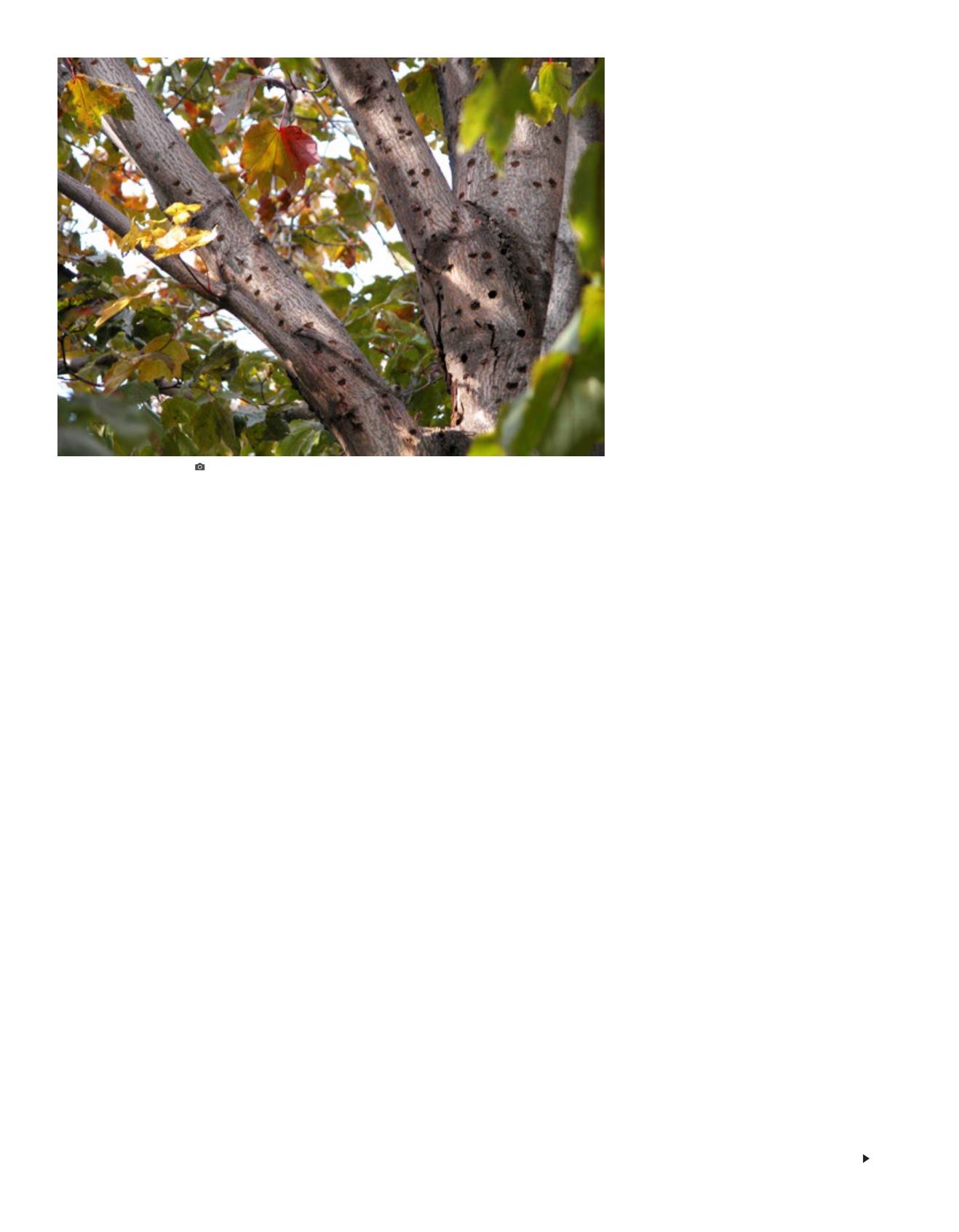
Asian long-hornedbeetle damage. ONTARIOMINISTRYOFNATURAL RESOURCESAND FORESTRY


