FALL2016
MLBLUE
43
words :: Leslie Anthony
Driving around Ontario, youmight have noticed
signs asking you not tomove firewood around.
There’s a few good reasons for that, but the
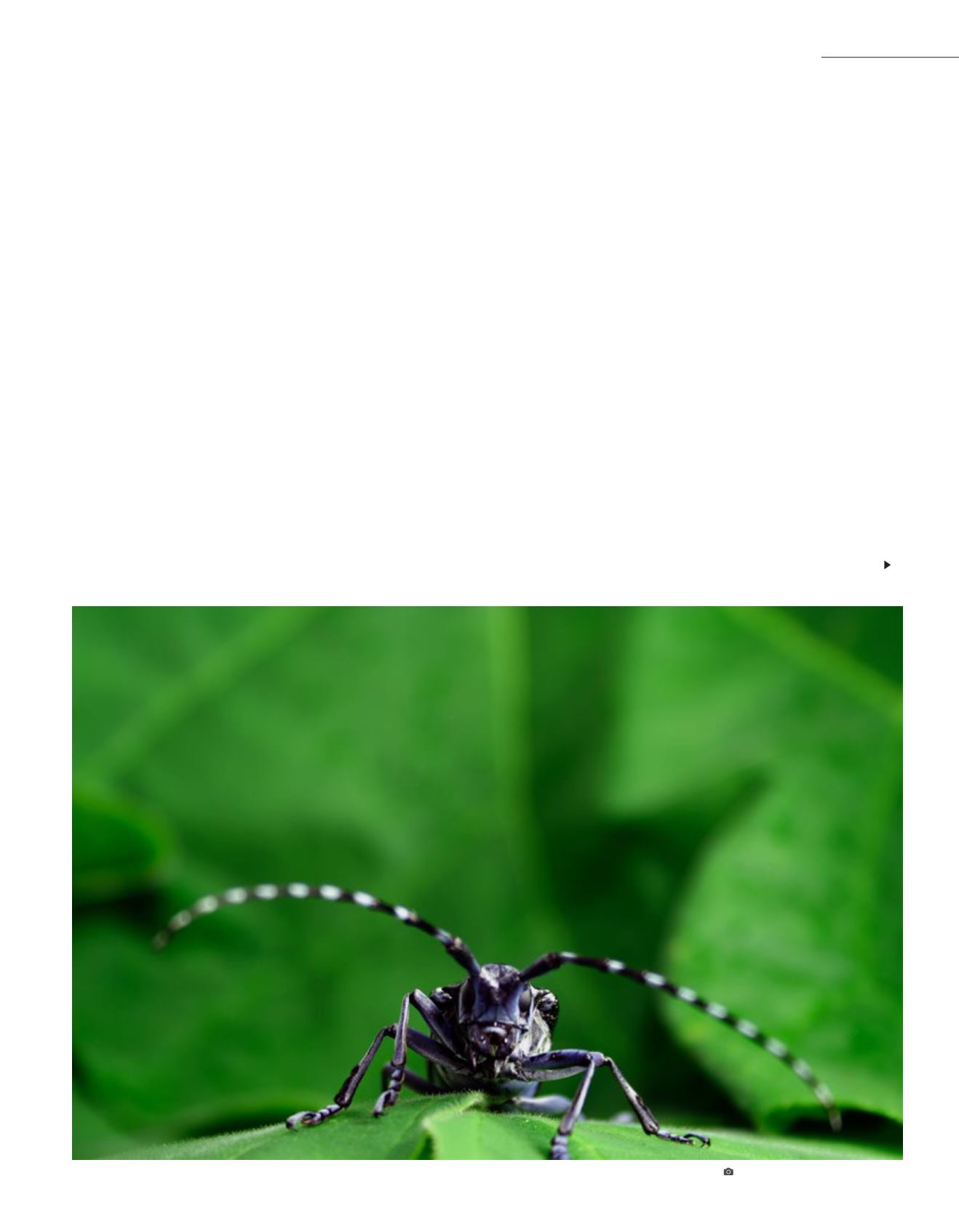
biggest one is only 3 centimetres long—a
black, longish beetle with a white-speckled
back and long, curving, striped antennae known
as the Asian long-horned beetle (ALHB). If
you live anywhere where there are trees—city
or country—it’s worth knowing about this
incredibly destructive invasive species and some
of its equally problematic nonnative buddies.
Troy Kimoto is a Survey Biologist with the
Plant Health Risk Assessment Unit of the
Canadian Food InspectionAgency (CFIA), and
a crash course on the risks to NorthAmerican
forests from invasive insects can be found in
his personal online photo gallery: the telltale,
meticulously spaced drill holes of ALHB; close-ups
of the under-bark vermiculations of emerald ash
borer; and the one-two depredations of deadly
Raffaela
fungus and its delivery vehicle, oak
ambrosia beetle. You could call these Postcards
from a Disaster.
Kimoto’s work with nonnative forest pests
focuses primarily on sap feeders and defoliators.
With dozens of these established andmore
knocking on doors around the continent, his
seems an unfathomably expansive job.
“I tried to break it intomanageable pieces,”
he notes. “We started out trapping to locate
nonnative insects, then implemented rearing
programs inmain entry points like Toronto,
Montreal and Halifax. I usually start by looking
at interception data for each pest to try and
develop the right detectionmethods. A lot of
what I do basically involves coming up with
newmousetraps. But I also identify gaps. For
instance, historically we’ve dealt mostly with
coniferous bark beetles in NorthAmerica, so we
have a good understanding of the tree volatiles
(aromatic chemicals) that attract them, but we
don’t have the same expertise with hardwood
pests like emerald ash borer.”
How could you? With some 15,000 species, the
jewel beetle family is one of the largest in all of
beetledom, making Kimoto’s worries over small
critters…well, huge.
Domestically, the CFIA tracks established
nonnative insects to see which new areas
these might be moving to; a second survey
BEETLEMANIA
UNDERSTANDINGNONNATIVE INSECTSANDTHEIRPOTENTIALLYDISASTROUS IMPACTONOURFORESTS
Pest in theWest.AnAsian long-hornedbeetle. KYLET. RAMIREZ /WIKIMEDIACOMMONS
BIO
PHILIAC


