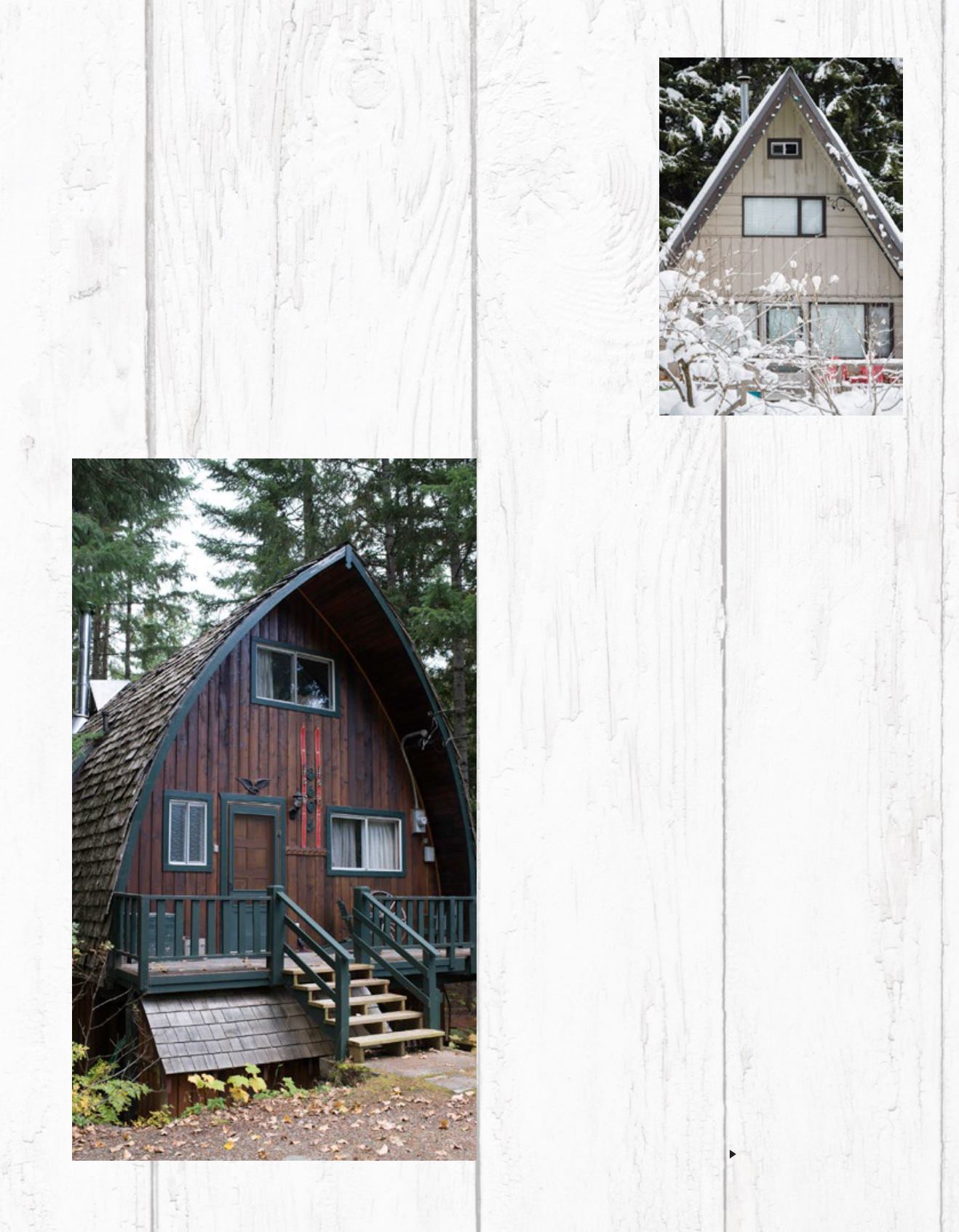
“It’s a simple structure that is inherently strong,” says long-time local home builder, Bob Deeks. “Very
fewwindows, so it’s self-supporting, and of course the walls become the roof with that ribbed upside-
down boat design. I would guess that even against modern snow load and seismic requirements, that
design stands the test of time.”
Created sometime in the 13
th
century as a way to build bigger church windows (and then bigger
churches), the Gothic arch was revolutionary for its ability to distribute weight over a broad open area
without collapsing. Good enough for the
NotreDamedeParis
; perfect for Whistler winter snow loads. But
as themoss grows heavier along their rooflines and the land beneath them grows in value, it’s easy
to wonder if the gusting winds of progress will sweep upWhistler’s A-frames just like somany other
historical buildings before. The answers, and salvation, may be found in the one of the very strengths
that madeA-frames attractive in the first place: they’re cheap, sturdy, and a little bit magical inside
…
THE ORIGINALS
In the late 60s and 70s, anyone with basic carpentry skills could have
a DIY Gothic A-frame kit shipped up from North Vancouver, starting at
around $12,000. “Cheap” has always been an integral part of ski culture,
so the Gothic “A” quickly became the go-to design for a weekend ski
cabin in a very unproven, and reputedly wild, little town in the mountains.
“Our street was still a dirt road, our basement was dirt,” says Ken
Melamed, who bought a newly constructedWhistler Gothic with his wife
Uschi in 1979. “We didn’t have any concept of the structure, it was just
affordable and the whole place smelled of freshly milled cedar, like a
forest. It was a true classic ski town cabin.”
1979 was also likely the start of the end for Whistler’s A-frames.
BlackcombMountain opened that winter, Whistler Village followed shortly
after, and as property values rose, the idea of a cheap and cozy weekend
ski cabin was replaced by larger, pricier andmuchmore luxurious dreams
of a “vacation property.” As the resort became more successful, many
classicWhistler A-frames were bulldozed in the name of progress.
The Melameds went the other direction, raising two sons in their A-frame
while making constant improvements to preserve it. Over the years,
they upgraded it with a finished basement, new roof, high-performance
insulation, ventilation and solar panels. “I think they are worth saving,”
Ken says. “One thing that surprises people about Whistler is the strong
sense of community here. And I really think these older homes and
ski cabins are a central part to that aspect of Whistler. An inventory
of affordable, simple homes will keep people here and make the
community richer.”
With 15 years of public service as a councillor andmayor, Ken says there
was talk of a heritage project to help preserve the disappearingA-frames,
but nothing ever came of it. “It is really challenging. Whistler is different
than a place like Quebec City, where a heritage home can go back 200
years. But even though these homes are only 30 or 40 years old, you feel
that magic every time you walk into one.”
“Itwasaffordableand thewholeplacesmelledof freshlymilled cedar,
likea forest. Itwasa true classic ski town cabin.”–KenMelamed
WINTER /SPRING2016
MOUNTAINLIFE
79


