38
MOUNTAINLIFE
SUMMER2016
fishingboats, they continue to turn awaymassive
drillingbarges and surveyors caught pullingup
vital eelgrass near the island,while the Port of
PrinceRupert publicly opposes their buildings.
On the twenty-thirdof January, 2016, leading
scientists, First Nations leaders and regional
politicians signedThe Lelu IslandDeclaration
(
leludeclaration.ca
) inPrinceRupert, asserting
that Lelu Island and adjacent Flora andAgnew
Bankswere hereby protected for all time as a
refuge forwild salmon andmarine resources, tobe
held in trust for all future generations. Soon after,
in February 2016, theCanadian Environmental
AssessmentAgency (CEAA) released its draft
report into the proposeddevelopment, prompting
130 scientists toquestion the“scientifically
flawed”document in a letter to the Feds urging
Minister of Environment andClimateChange,
CatherineMcKenna, to reject it.A key concern
was that the report blatantly ignored effects an
export facilitywouldhave on the ecology of the
Skeena estuary, failing to even acknowledge that
the terminal was locatedon critical habitat of
Canada’s second largestwild salmonwatershed.
“Frommy time innorthern communities, I’ve
learned there are real concerns about creating jobs
–but not those that could impactwild salmon,
the area’s economic and cultural backbone,” says
climate activist and snowboarder,TamoCampos,
who spends abundant time both in the area’s
mountains andon the groundwith First Nations
groups, andwho recently co-produced
Last Stand
for Lelu
, a film to raise awareness and funds for
the Lax Kw’alaamswarriors. But Campos believes
this issue hasmuch larger implications than just
Lelu island.
“I’ve also seenwinters deteriorate inmy lifetime
from climate change,”he adds,“and the fight
against Petronas is a frontline for stopping it.
Proponents continually greenwash LNG as a
transition energy source away from fossil fuels, yet
their numbers are based solely on end-point use
anddon’t consider upstream extraction emissions
from fracking,which consistently leaksmethane, a
greenhouse gas 25 timesmore potent than carbon
dioxide, over a 100-year cycle.”
Even theCEAA agrees, stating that the project’s
carbon emissionswouldbe“high inmagnitude,
continuous, irreversible andglobal in extent.” It’s
hard to imagine a projectwith that kindof liability
evenbeing considered in today’s climate-shocked
world, a fact theDavid Suzuki Foundation voiced
ina release:“All thosegreat ideas to stop climate
changewon’t havemuch impact if thegovernment
alsoapproves large carbon-pollutingprojects like…
Lelu Island… If built, thiswouldbeoneof the
largest carbonpolluters inCanadawhenupstream
emissions (e.g., from extraction, processing
and transportation) are factored in… similar to
Canada’s two largest carbonpolluters—anoil
sands operationanda coal-firedpower plant.”
Meanwhile, researchpublished in the prestigious
journal,
Science
, shows that 88per cent of Skeena
salmon— 330million smolts per year— rely on
FloraBank for protectionduring their formative
years.“If the project is built, itwouldbe ignoring
science and ignoring the risk to salmon and to
people,” says Simon Fraser University biologist,
JonathonMoore.
WithFederal cabinet approval of theNational Energy
Board recommendationspending, the fight for Lelu
isheatingup.“This fight really isDavidandGoliath,”
saysGitwilgyootshouse leader,GwisHawaal.“We’re
fighting amassive company that has awhole lot
moremoney andpower thanwe do.”
True. But they know how the David and Goliath
story ended.
Go to
towatch
a trailer for Tamo’s film
Last Stand for Lelu
and
learnmore.
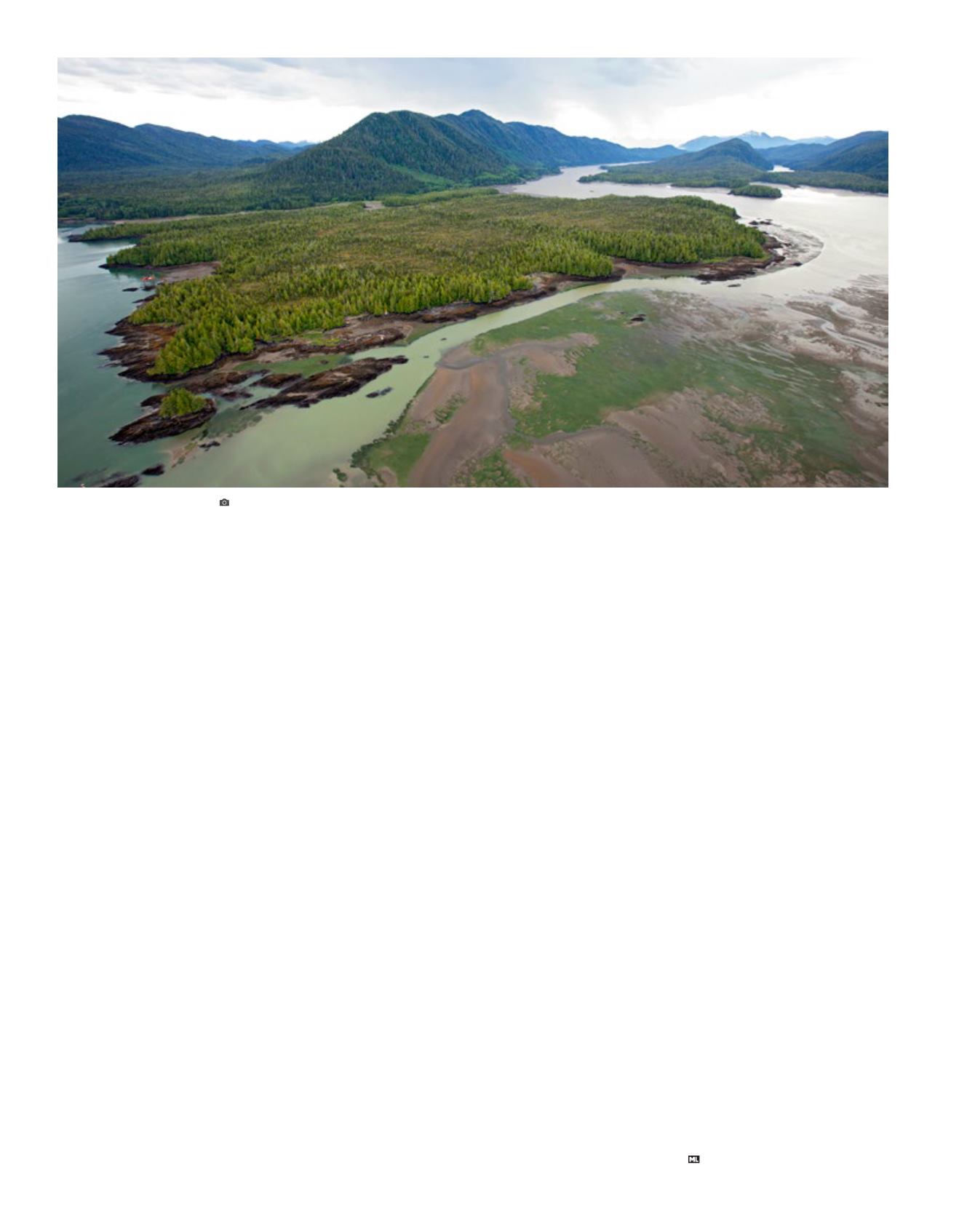
Is this the right place for heavy industry? BRIANHUNTINGTON
The report blatantly ignoredeffectsanexport facilitywouldhaveon theecology
of theSkeenaestuary, failing toevenacknowledge that the terminalwas located
on critical habitat of Canada’ssecond largestwildsalmonwatershed.


