SUMMER2016
MOUNTAINLIFE
37
Each spring, an invisiblemigration takes place
from the creeks and lakes of northwest British
Columbia’s SkeenaRiverwatershed.Hundreds of
millions ofwildChinook, coho, pink, chum and
sockeye salmon smolts reared in thesewaters
descend to the PacificOcean for the second
stage in their celebrated life cycle.Ahistorically
important food source for the region’s First
Nations, these five species today comprise the
second-largest salmon run inCanada, a basis
for sustainable, recreational and commercial
fisheries, aswell as ecotourism– sectors inwhich
thousands are employed.Of particular importance
to the vulnerable smolts, as they transition from
freshwater to saltwater, is the habitat providedby
eel grass and seaweedbeds surrounding islands
in the river’s estuary.According toCharmaine
Carr-Harris of the Skeena Fisheries Commission,
“You couldn’t find aworse location [for industrial
development] in terms of risks to fish.”
And yet this is preciselywhat Christy Clark’s BC
provincial government –withhelp from the Feds –
appears bent ondoingwith a liquefiednatural gas
(LNG) terminal on Lelu Island.At Lelu, a pipeline
proposedby PrinceRupert GasTransmission,
subsidiary of oil-and-gas giant TransCanada,would
deliver frackednatural gas from the northeastern
corner of the province to an $11.4billion
liquefaction, storage and export plant operated
by PacificNorthWest LNG, a local consortium
controlledbyMalaysian state-ownedPetronas,
whose total end-to-end investment in the project is
touted at $40billion.Given the risk to the Skeena’s
salmon, protest against the overall planhas been
particularly strongwith regard to the Lelu facility,
withno voices louder than thosemost reliant on
the area for traditional foodgathering andother
cultural traditions.Although the Port of Prince
Rupert, a federal body, claims administrative aegis
over these putative crown lands, theGitwilgyoots
have a differingoutlook, as they fall within its
traditional unceded territory.
In the springof 2015, the tinyGitwilgyoots
community of Laxkw’alaams shocked the
worldwhen it unanimously voted against
the Leluplant despite a $1.15billion
enticement.“Hopefully the publicwill
recognize that unanimous consensus... it
sends anunequivocal message,” saidband
mayor,Garry Reece.“This is not amoney issue: this
is environmental and cultural.”
BothPetronas andgovernments ignored the vote.
InAugust 2015,with company barges drilling into
sandbanks and cuttingdown culturallymodified
trees on Lelu Island, theGitwilgyoots escalated
their stance. Bandmembers and supporters
occupied Lelu, signaling their intention to settle in
for the longhaul by constructing cabins.On tiny
LELU’SLAST STAND
ENVIRONMENT
By Leslie Anthony
“This fight really isDavidandGoliath,we’re
fightingamassive company that hasawhole
lotmoremoneyandpower thanwedo.”
–GwisHawaal, Gitwilgyootshouse leader
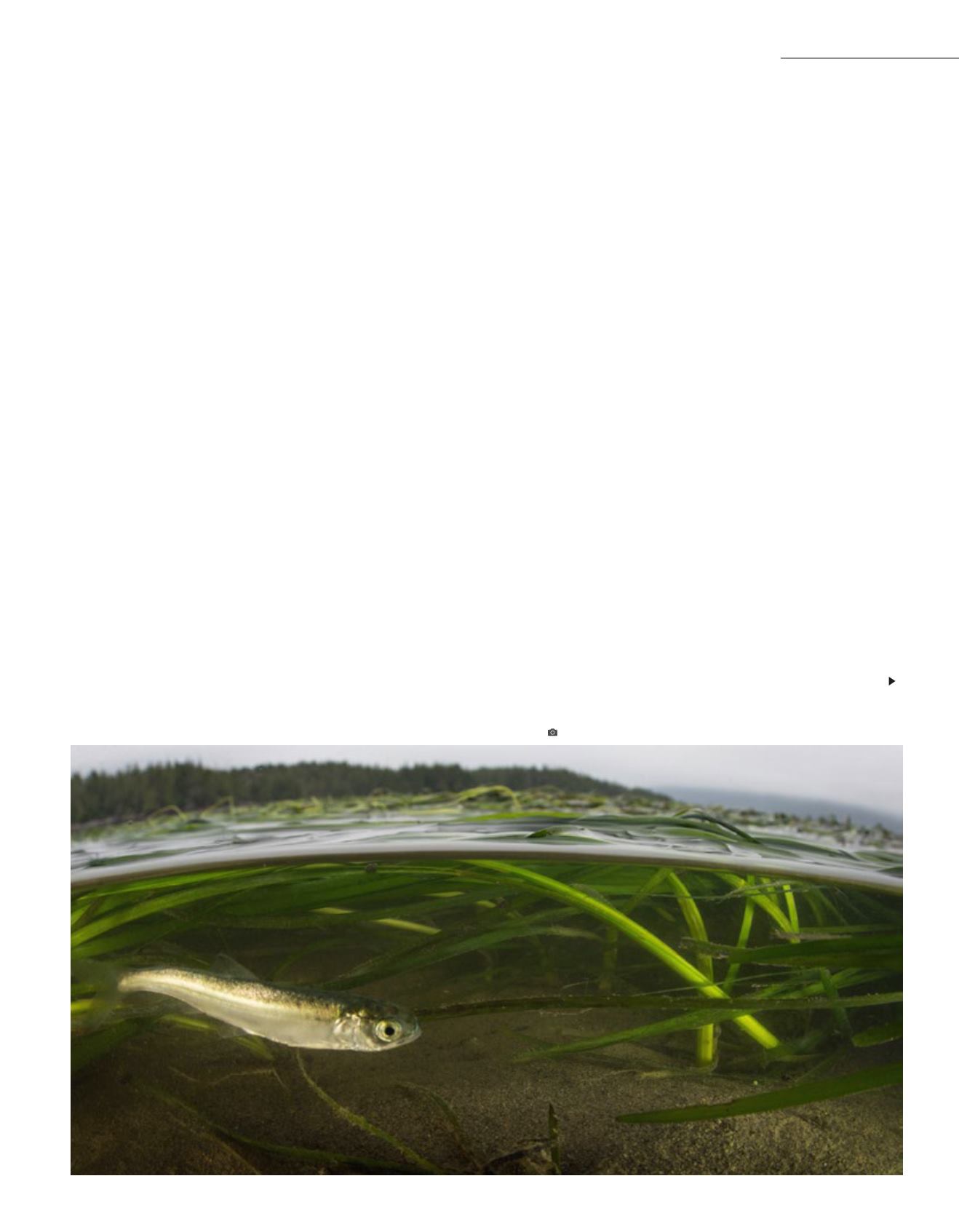
Eelgrass provideswild salmon smoltwith important protection and foodbefore they are able tomove out toopenwater. TAVISHCAMPELL


