146
MLBLUE
WINTER2017
BACK
PAGE
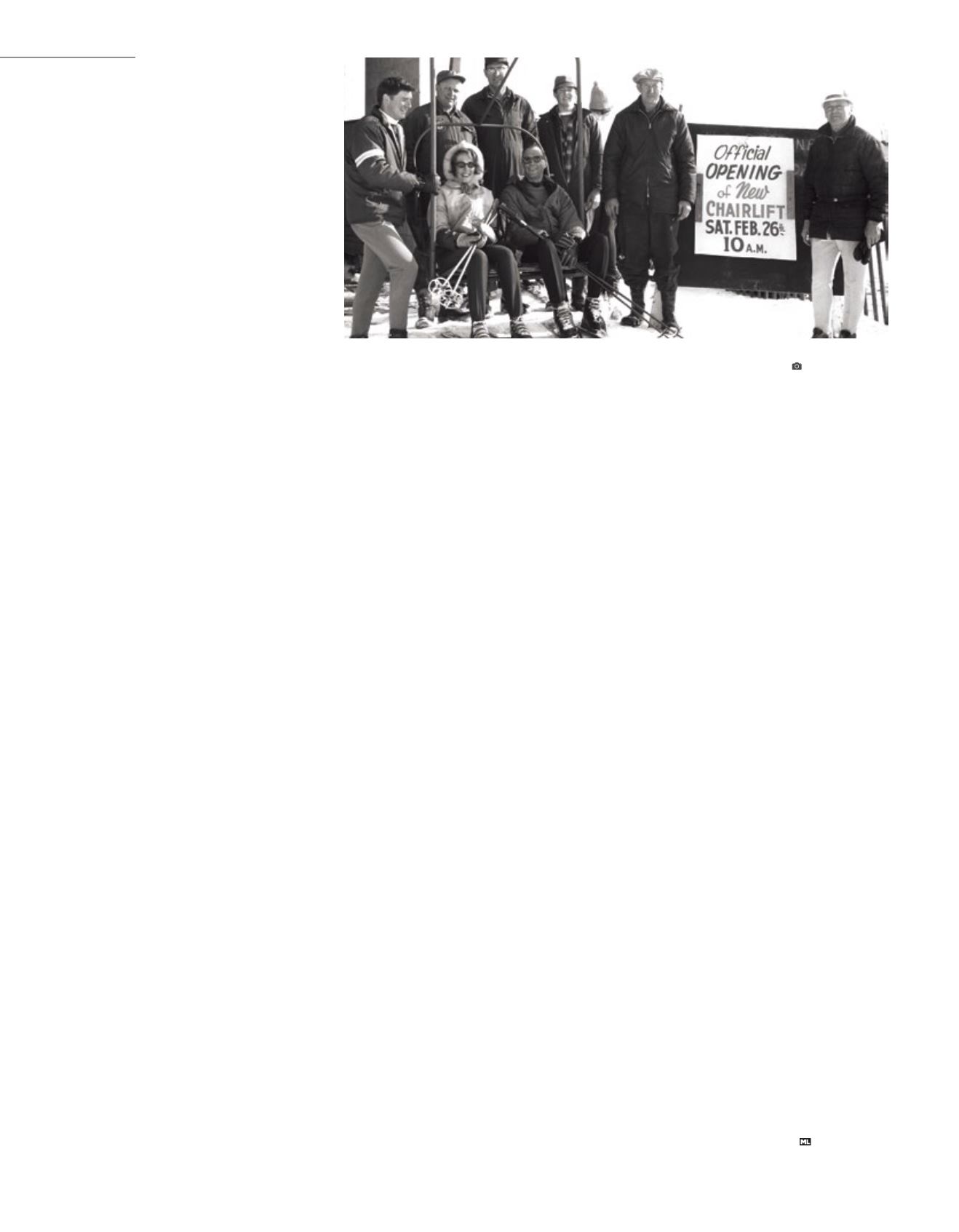
Thisphotocameupearly inour research forour
BlueMountain75
th
anniversary issue. Atfirstwe
noticed thechairlift riders, inparticular theguywho
remindedusof
MadMen
’sDonDraper. Thecouple is
posing for theofficial openingofBMR’sNorthChair,
winter 1966.But theguysbehind thechairlift tell the
larger storyof theResort’sevolution. Today’sBMR
President andCOO,DanSkelton, has two familial
connections to thisphoto: his fatherBill (standing
at far left) andhisgrandfatherKen (standingfifth
from left).We recentlyspoke toDanabouthis
multigenerational historyatBlue. –Ed.
MountainLife:Tell uswhat your remember
aboutKenSkelton, yourgrandfather.
DanSkelton:
He worked on Great Lakes
freighters shovelling grain and shovelling coal.
He was a farmer in the area, a machinist and
a welder, and worked for the [Collingwood]
Shipyards for a while. He was the handiest
all-around guy in the construction of the first
lifts and the building of the Resort in the ‘40s
and ‘50s. And in the ‘70s I remember him in the
Blue Mountainmachine shop.
ML:Whatwereyourfirst jobsatBlue?
DS:
I startedworking at Blue when I was 13,
when they put the Slide Ride in; I picked garbage
in the parking lot and after that I worked lifts:
rope tows, the Poma lifts, and then on theApple
Bowl chair. Andwhen they opened up night
skiing in the South end, I worked the O-Hill lift,
and thenwhen I was 18 I joined the Ski Patrol.
ML:Your father,BillSkelton, startedatBlueas
a teenager in the ‘50sandwenton tobeVPof
Operations.
DS:
My father was part of that technological
revolution at Blue when the first Poma lifts and
chairlifts were installed. There were a lot of bad
winters back then and there wasn’t a tonne
of money to bank on or business to borrow
against. So BlueMountain was super frugal.
Instead of buying a lift from Poma they would
buy the plans and then build the lift themselves.
It was a different world—very hands-on. (I don’t
know how long you lived if you weren’t handy
back then. My dad is incredibly handy. I went
to school for engineering and I’m not nearly as
handy as he is.)
Everything was designed as a production line.
In order to build 100 chairs for the lift, you
had tomake sure every chair was exactly the
same. I remember working with a welder from
Czechoslovakia named Tony Posta who built
tanks duringWorldWar Two. He was always
focused on how tomake something as precise
and repeatable as possible, and as efficient
as possible. I marvelled at the time he spent
building a jig, thinking, “Let’s get to it, let’s start
cutting.” But hewould say, “Cutting nowwill get
you one, but then howwill you get the next 100?”
ML:Do thesepracticesstill apply toBMR today?
DS:
Absolutely. When we did our snowmaking
project, we made 300 of one thing, documented
the process, and assembly-lined it. And It’s true
for lift shacks, for any retrofits we do. We don’t
do as many retrofits on lifts because we’re a
different kind of business now. But the idea—
that anytime you do something more than
once, why not do it the same?—extends to our
service philosophy today.
ML:Whatcanyou tellusabout the futureofBMR?
DS:
Our new reality is that we have a Village
and a 1000-room bed base that depends to
some extent on a consistent snow season,
especially Christmas. So we’ve been looking
at the snowmaking technology landscape and
satisfying ourselves that there are enough
solutions and enough responses with existing
technology tomore than counter the impacts of
climate change. We’re still very focused on being
responsible environmental stewards, trying to
reduce our carbon footprint, trying to be more
efficient. The trend is towardmore efficient,
warmer-weather snowmaking guns. We’re slowly
adjusting our snowmaking intensities, as well
as LED lighting that we’re planning to apply to
night skiing.
The other big change is the four-season
diversity that we keep building towards. The
investments we’ve done for the summer have
been very powerful for us. It used to be that
February was our biggest month in lodging but
now for the last three years it’s been July and
August. We have a lot of projects inmind for
the future that I can’t get into specifically but I
can say that they will work towards making us
more seasonally diverse, though the emphasis
will never really come off winter. One thing
that our conference business and the summer
activities have shown us is that there’s a lot of
demand for what we have to offer. There is a
very strong demand for just about anything we
build as long as we stay true to our principles—
which are based around the outdoors and being
active. As long as we stay true to that, I think
the future’s pretty bright for us.
THEGUYS
BEHINDTHE
CHAIRLIFT
DANSKELTON’SGENERATIONSOFBLUE
Official openingofNorthChair, February1966. (L-R) Bill Skelton,Art Horner,RonSheridan,
KeithNeil,KenSkelton, JozoWeider.Chairlift riders unidentified. FRITZSCHULLER/BMR


