14
MOUNTAINLIFEBLUEMOUNTAINS
SUMMER2016
NED
ITORIAL
Famed French scubapioneer andexplorer JacquesCousteau is a familiar, red-
capped figure toanyonewhowatched television from the1960s to the1990s.
His documentary-film stylewas conversational, inviting you tohangout on
deckwithhis laid-backbut intrepid crewand their quiver of grown-up toys,
includinganunderwater scooter, adiving saucer, andagyrocopter. From the
Mediterranean toEaster Island toPapuaNewGuinea, their expeditions knewno
borders.Cousteau’s explorations often targeted familiar places and cast them in
new light, seekingoutmysteries andwonders bothmarineand terrestrial.
Coproducedwith theNational FilmBoardof Canada and released in 1982,
St.
Lawrence: Stairway to the Sea
is a film in keepingwith thework of Cousteau’s
later years,whenhe became increasingly concernedwith environmental
degradationof global waterways. (You canwatch the film at nfb.ca.) Cousteau
was keenly aware of humanity’s clashwithnature but in the later films he
andhis crew, for all their heavy exploratory hardware, seemed to reach a deep
confluencewithnature, and strove to share that.
To film
St. Lawrence: Stairway to the Sea
, Cousteau’s ship
Calypso
sailed into
themain artery of the St. Lawrence Seaway System—whichdrains roughly a
quarter of the planet’s freshwater reserves—to theCanadian shores of the
Great Lakes.They explored various points of interest both famous andobscure;
off Tobermory,Ontario, the crew filmed the site of an ancient, now-submerged
waterfall,whichprobably carried asmuch volume asNiagara Falls, inwhat
is now Fathom FiveNationalMarine Park. Continuingon to the north shore
of Lake Superior, Cousteauwas the first to film thewreck of the
Edmund
Fitzgerald
and also stoppedover at the Slate Islands, now a provincial park.
(In1975 a life ring from the doomed shipwashedupon the Slates; it is now
displayedon themainland inNeys Provincial ParkVisitor’s Centre.)
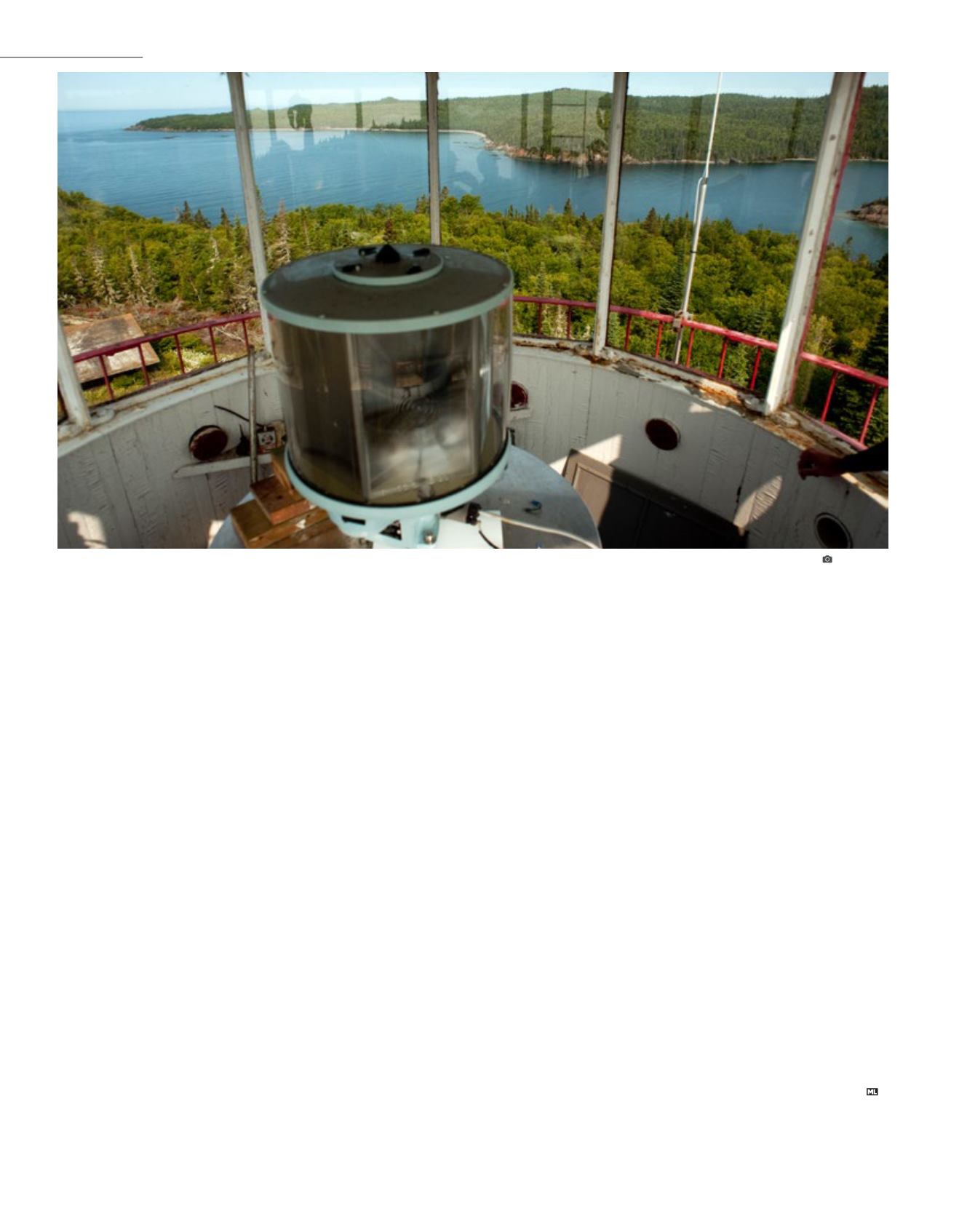
Last summer I visited the Slate Islands by kayak and as I lookedout over
Lake Superior from the rickety old lantern roomof the lighthouse, I recalled
Cousteau’s film: his seaplane flyingoverwhere I stood; his crew filming the
archipelago’swoodland caribou at play. Superiorwas placidon that day but as
always a faintlymenacingpresence, paralyzingly cold inmidsummer and able
togeneratewaves that 40 years before, swallowed the biggest freighter the
Great Lakes had ever seen. For all the lake’s legendary fury, I reflected, it also
provides a tranquil refuge for a vulnerable, island-dwelling caribouherd that is
unlike any other in theworld.
Mysteryandwonder exist in spades in theGreat Lakes.Youdon’t needa seaplane
or a diving saucer todiscover this.To seek tounderstandhowpeople and
nature canhappily coexist here is the discoverywe shouldbe reaching for.
—Ed.
As I looked out over Superior from the rickety old lantern
room of the lighthouse, I recalledCousteau’s film.
GREATLAKESMYSTERYANDWONDER
Inside the Slate Islands lighthouse, lookingnorthwest. GLENHARRIS


