32
MLBLUE
FALL2016
words :: Scott Parent
If you want to learn something about
local weather, ask a local diehard paddler,
kiteboarder or surfer. To paddle or surf
effectively on big lakes requires knowledge
of the weather events that propagate waves
and chop. There are plenty of apps out
there offering wind reports, buoy readings,
barometric models, and wave-height
predictions. Yet even with all this information,
knowing how to interpret it requires relatable
on-water know-how and experience.
On a typical SUP, sea kayak or canoe trip youwill
probably end up paddling inmultiple directions,
and knowing how the windwill line upwith your
route is very useful knowledge. Preferably, you
will want the wind blowing from behind you,
pushing you along your intended course. But
this is not always possible and on longer trips,
paddling into stubborn broadsides or persistent
headwinds is often unavoidable. Want an on-site
visual reference for wind direction on open
water? Look for Langmuir spirals.
If you’ve spent much time in boats, you’ve
probably seen long lines of foam running
parallel to each other on the water surface.
These windrows (or slicks) are produced by
Langmuir spirals—also known as Langmuir
circulation—named after the American
physicist Irving Langmuir who first observed
the phenomenon in seaweed in the Sargasso
Sea. The spirals form in various speeds and
frequencies and express a complex series of
effects at play, mostly the result of wind action
on the water surface over a period of time.
When paddling if you point your compass north
then add the direction of the windrows, you
can observe the prevailing wind direction. But
Langmuir spirals are interesting beyond their
practical use as a wind compass; much more
is going on than wind and water traveling in a
series of parallel lines. The spirals also reveal
the direction of currents and can help you use
them to your advantage—making the difference
of hours of effort on a coastal tour. Spirals tell
us how the winds line up with the coast, and
which direction we would drift if we were to
stop paddling.
Langmuir spirals consist of vortices of wave
energy travelling between the windrows,
produced by the prevailing wind dragging the
surface of the water. A volume of water has
to replace what has been pushed forward by
the wind’s traction. Regular series of upwelling
and downwelling zones take form between the
vortices, producing the peaks and troughs of
the windrows. The foam is stirred-up
biofilm that generates from the spirals
as they mix surface layers with deeper
layers of water. The mixing of layers
produces phytoplankton and bacteria
concentrations in the surface water. This
effect draws larger zooplankton up to
feast opportunistically. In turn, larger
feeders follow up on the food chain,
such as minnows and cyprinids, and these
follow suit by attracting predators likewaterfowl.
All told, Langmuir spirals churn thewhole life-
aquatic intomotion. And you thought they were
just bubbles in the water.
Studies on this phenomenon are many, and we
won’t dive any deeper here. But do remember
them as an invaluable navigational aid. When
you’re on the open water and want to know
which way the wind blows andmore, look to
the Langmuir spirals to guide you home.
Langmuir spirals consist of vortices
ofwaveenergyproducedby the
prevailingwinddragging thesurface
of thewater.
HOW
TO
SPIRALHOME
HOWTONAVIGATEONWATERUSINGLANGMUIRSPIRALS
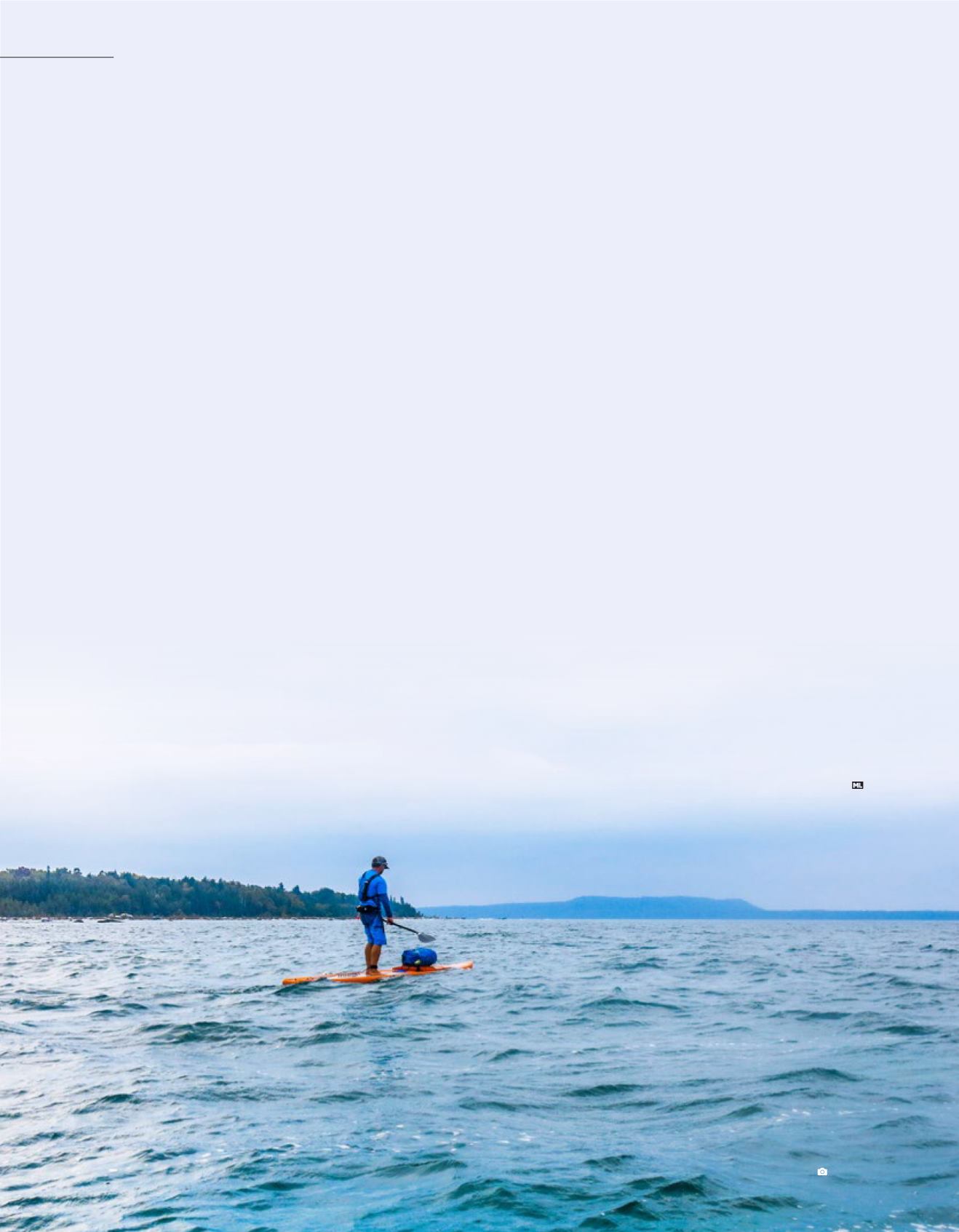
AaronPilon roundingHope Island,GeorgianBay.Notewindrows in foreground. SCOTTPARENT


