WINTER/SPRING2017
MLCM
35
"If nothing isdonea lot of fishwill dieasa
pre-spwanmortality...Wewere lookingat
losing theentireSteelheadpopulationby2019
andonly remnantsof theCohowould remain."
–BrianSmith
When he first arrived on site and saw the effects of the slide, Smith
remembers feeling his heart sink. “This was more than a problem, at
the moment all I could think was; something has to be done. But what?
And how?”
The first step was organizing a round table involving all concerned
parties; stakeholders in the health of the salmon run. This collective was
comprised of members of the District of North Vancouver, the City of North
Vancouver, Metro Vancouver, Department of Fisheries and Oceans, and
the BC Provincial Government, as well as two First Nations Bands – the
Skwxwu7mesh (Squamish) and the Tsleil-Waututh (SLAY-wah-tooth) –
whose territory the Seymour River passes through.
“We all came together and formed a partnership,” Smith says, “with our
one goal being to reintroduce migration passage through the Seymour
Canyon for adults and juvenile salmon alike.”
Northwest Hydraulic Consultants Ltd. was brought in to advise on possible
next steps. They brought nine options to the round table and by the end
of the discussion the members had agreed on using a low-velocity rock-
breaking product to reduce the size of the debris, allowing the natural
flow of the river to disperse and reshape the waterway. Those worker ants
in the box canyon are operating 45-pound pneumatic hammer drills that
average about 2,200 blows per minute at 90 PSI (that’s the equivalent to
drilling a hole the height and width of a stop sign post in about an hour).
Transporting equipment like that over flat ground is a laborious task in
itself. To get them down a cliff and over the debris to the toe of the slide
requires a web of ropes, pulleys and expertise to ensure safety.
To properly clear the debris will require $1.2million over five years and
the not-for-profit SSS (with it’s humble staff of three full time employees
and one seasonal aid) are expected to raise the money, on top of the
regular duties of maintaining the hatchery. For the past two years,
Brian Smith’s life has been bound in the shackles of bureaucracy and
fundraising. It seems the fate of the Seymour salmon is now hinged on
the countless emails and funding proposals of one man.
But in the canyon, progress. AGlobal RockWorks Inc. team has lowered,
loaded, packed, and wired together charges and sand in preparation for a
blast. A continuous circuit of yellow blasting wire leads out of the canyon
to a safe zone and the high-vis ants scurry over the boulders, evacuating
the canyon while salmon jump in the waters below the slide, excited and
impatient to continue upstream.
A fewmoments later, an air horn sounds 12 times in short succession, a
two-minute warning. Then, with a pop, gasses ignite and seek weaknesses
in the rock. Smoke rises from the canyon and three truck-sized boulders
crumble into piles of rubble. But behind them, a few dozenmore sit
unmoved and indifferent. The salmon will have to be patient with us.
Formore infoor todonatego t
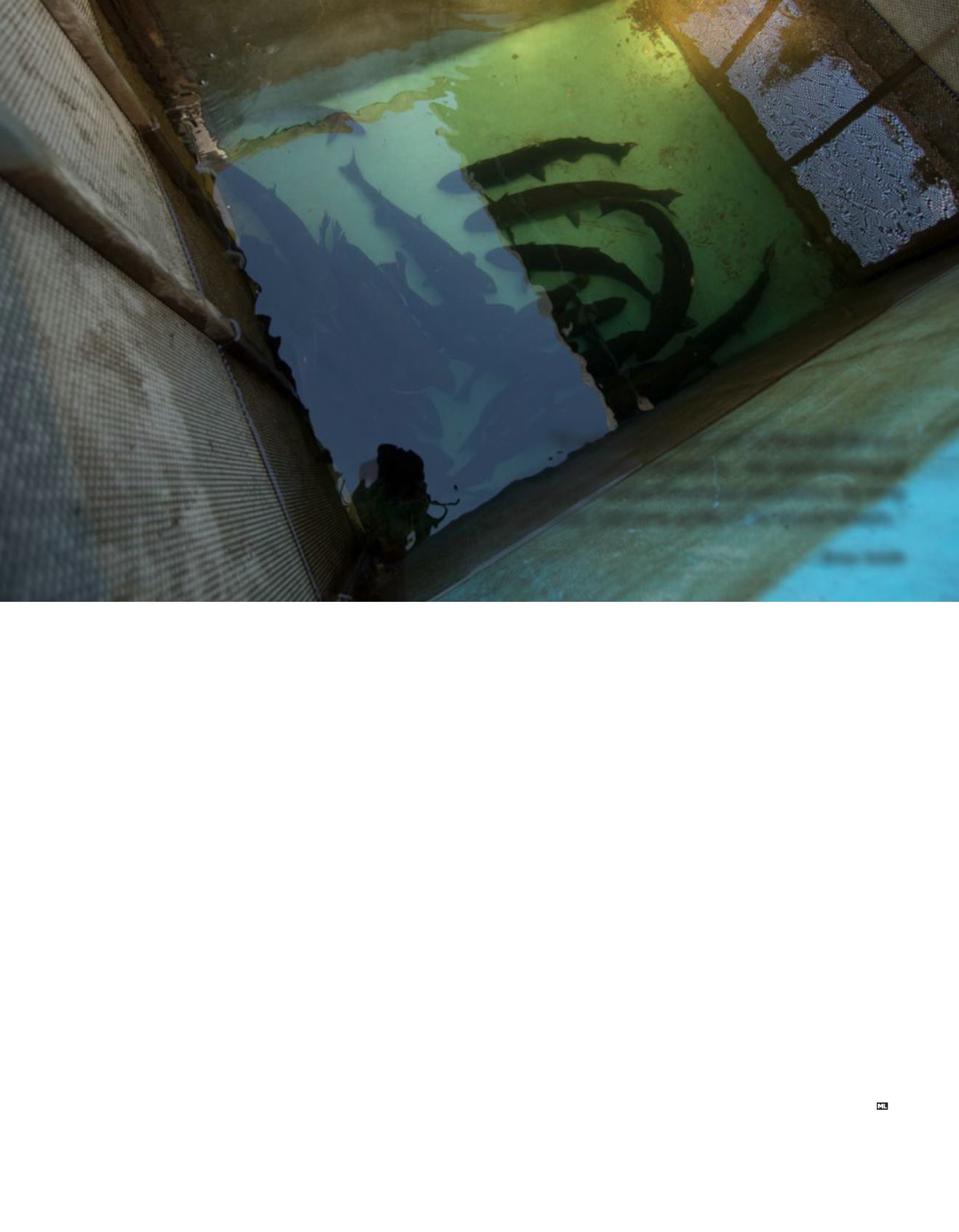
Ready togo.Coho salmon from theSeymour Hatchery.


