The small but mighty HOVERAir X1 PROMAX pilots itself—and will follow you into an unlimited adventuresphere.
Words :: Ned Morgan
Capturing aerial footage used to mean packing a large, pricey drone and devoting serious time and effort to learning how to fly it. For many solo adventurers, that usually wasn’t an option—until now.

Meet the HOVERAir X1 PROMAX. At under 7 ounces (192 g), it’s so compact that even the DJI Mini looks massive by comparison. Its folding design, combined with a full protective cage around the propellers, means you can slip it into a coat pocket or toss it into a backpack without worrying about damage. It’s the kind of powerful gadget you’ll find yourself bringing along without a second thought, right next to your jackknife, phone and granola bar.
Designed for autonomous flight, this palm-sized drone will launch from your hand, track your movements and record 4K or 8K footage. It’s a little pricier than its main competitor (DJI Flip) but offers significantly more kick.
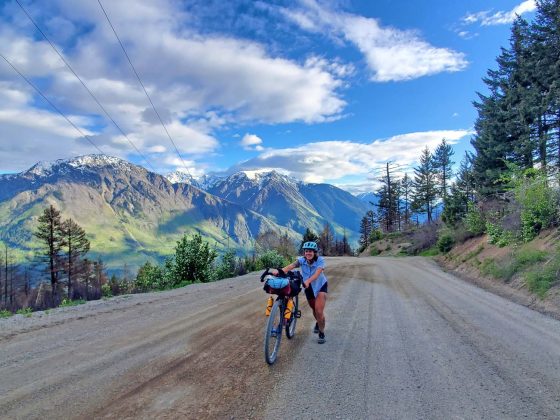
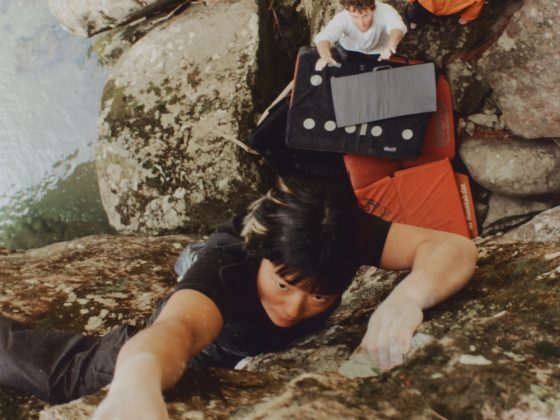
The X1 PROMAX is an appealing premium content tool for hikers, cyclists, climbers, runners and other outdoor creators who want high-concept documentation of their adventures without carrying extra gear or relying on someone else to fly a drone.

Grab-and-Go Flight
At the heart of the HoverAIR X1 ProMax’s appeal is its unbeatable autonomy. With built-in facial and body recognition, the drone can identify and track its subject—no controller required. Simply unfold the wings, power it up, and press a button. It takes off from your hand, locks onto you, and begins flying one of the 15 flight patterns of your choosing.
It’s an appealing tool for hikers, cyclists, climbers, runners and other outdoor creators who want to document their adventures without carrying extra gear or relying on someone else to fly a drone.
These modes include “Follow,” where it trails behind as you move forward, and “Hover,” where it stays in place but rotates to keep you in frame. “Orbit” circles around you, “Zoom Out” starts tight and pulls back for a wide shot, “Bird’s Eye” hovers above looking down—these last two benefit from the camera’s ultrawide 107° field of view—and “Dolly Track” flies backward in front of you, maintaining a cinematic framing. There is also a Ski mode and a Cycle mode, tuned to follow you while you shred, so you can focus on your turns or on the trail ahead.

All this is made possible by proximity and vision-based sensors, advanced trajectory algorithms and a dual-axis gimbal-stabilized camera system working together to produce smooth, crisp video without a pilot—even during the extremes of motion. The ability to initiate these self-flights with one button makes this drone especially useful when your hands are full or gloved up.
Rugged for Real Conditions
With a tough but flexible exoskeleton protecting the props, the X1 PROMAX was clearly designed with outdoor use in mind. And unlike earlier models, it can now fly over reflective surfaces like water, snow and sand thanks to upgraded sensors. That’s a big deal for paddleboarders, backcountry skiers and beachgoers who previously had to worry about confusing the optical flow systems of compact self-flying drones. (However, I would not advise launching the X1 PROMAX from a boat or paddleboard. I launched it from a paddleboard for a Bird’s Eye flight, and upon return, it was skittish and didn’t want to land. I had to grab it in mid-air; I was lucky I didn’t drop it in the river. Next time, I would launch it from shore, a good distance from water.)
To extend the outdoor stoke, the X1 PROMAX now offers up to 16 minutes of flight time per charge, which is enough to capture multiple sequences on a single outing. This may not feel record-breaking, but given the drone’s tiny size, it’s respectable—and you will want to carry a spare battery (or three). Swapping the battery takes about 5 seconds.


The improved top flight speed—up to 42 km/h (26 mph)—helps the X1 PROMAX keep pace with faster sports (ie, mountain biking, skiing/snowboarding) while a longer control range (now 500 metres) adds more access to open spaces.
It now features a rear-facing collision avoidance system, which is particularly helpful when using “Dolly Track” mode, where the drone flies backwards. That said, it’s not foolproof—I had a minor collision with a tree branch during a test-flight, so while the sensors help, you still need to be very mindful of your flight path (especially while flying in manual) in enclosed surroundings like forests or around buildings.
The App
While the drone can operate on its own when self-flying, the manufacturer ZeroZero Robotics provides a mobile app for iOS and Android. The app lets you adjust flight and image settings, manually fly the drone via your mobile device, and download or preview footage.
Though not essential for basic self-flying modes, the app adds a lot of functionality, especially if you want to fine-tune how the drone behaves or need more control over framing. For instance, in manual mode, you can pilot the drone like a traditional quadcopter, using the app’s touch controls on your mobile device screen. And of course, you will also want to use the app to sort and upload video/photos after shooting.


The Beacon: Non-Essential for Minimalists, but Powerful
The optional Beacon (with joysticks) is a palm-sized remote (with a crisp but small OLED display) that replaces the app and provides dedicated control. It boosts connection range (up to 1 kilometre in an unobstructed environment), gives you live video previews and offers enhanced positional tracking.
You can dock the Beacon into a joystick module—or a pair of them—for more hands-on control. You can also dock your phone into the combo Beacon/joysticks for a larger screen alongside dual controls. If you grew up with joysticks and prefer them, you will want this option. I didn’t grow up playing video games so I find the joysticks less intuitive. (When flying manual, I found the app’s touch controls easier to use.)


There is even a one-handed motion control option for the Beacon (see photo above, top left) with haptic feedback that I couldn’t get the hang of—but again, longtime video gamers might find this option more intuitive.
If you’re rushed or travelling ultra-light, you may not want to bother with the Beacon/joysticks. I found myself often opting to leave them behind and simply use the HOVER app on my phone if I wanted manual control and/or a screen to watch the action (and if I knew I wouldn’t need the extra range provided by the Beacon). But if you’re using the X1 PROMAX on a bike a lot, you may want the Beacon, which mounts on your handlebars. (It will also attach to a pack or pocket.)
Forgoing the Beacon means you cut your potential flying range in half; however, the 16-minute fly time limits your ability to get the most out of a longer range, even if you have extra batteries. In any case, this isn’t a long-range drone. And the X1 PROMAX lacks the advanced obstacle-avoidance of a bigger, full-featured drone like a DJI Mini, so I would be careful flying it at a great distance unless I was on safe, open terrain where I could keep eyes on it.
HOVERAir X1 ProMax: A Solo Outdoor Content Creator’s Bestie—Even if You Don’t Shoot in 8K
While the Beacon accessory isn’t essential (unless you want joysticks), the drone itself overdelivers on its promises. It’s a smart investment for adventurers who want to elevate their visual storytelling without complicating their gear loadout.

If 8K footage isn’t essential for you, the more affordable HoverAIR X1 PRO—which offers 4K video and many of the same features—could be a better fit. I haven’t shot in 8K because I lack the software powerful enough to process and edit it. I’m sure it looks killer—and shooting in 8K will double your zoom capability—but for my needs, shooting in 4K (at various frame rates) is more than good enough. One other advantage of the PROMAX over the PRO is that it shoots stills at a higher resolution (48MP compared to 12MP).
All things considered, the HoverAIR X1 PROMAX is one of the raddest new tools for outdoor recreational filmers. It’s impressively compact, built to withstand rough outdoor use, easy to operate and produces high-quality footage with minimal effort. Whether you’re capturing a summit push, a singletrack descent or a paddle along the coast, this drone will follow along without adding bulk to your kit.
Summary
Price: $699 CAD for HOVERAir X1 PROMAX. (The X1 Pro is $499.) Add Beacon and joysticks for $228. You can also choose from various bundles.
Video Quality: Up to 8K at 30fps.
Battery Life: Up to 16 minutes per battery.
Storage: 64 GB internal memory. Slot for MicroSD card.
Sensors: Rear collision avoidance, downward optical flow for water/snow. Rated to withstand winds up to 24 MPH. Will fly up to 18,000 ft.
App: Optional for manual control and footage management.
Ideal For: Solo adventurers, trail athletes, travel vloggers, minimalist filmmakers.
Full details here.

Check the ML Podcast!